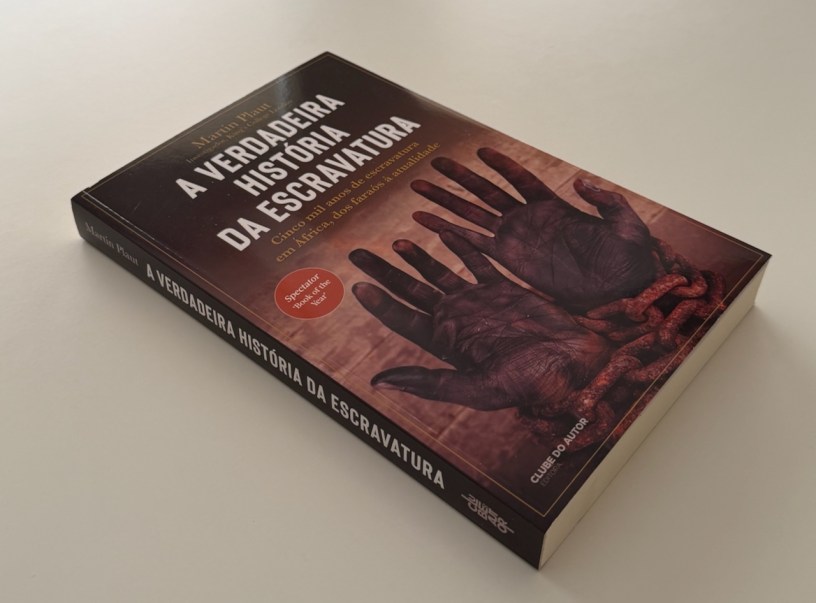
Source: Jorge Andrade SAPO
October 26, 2026
Martin Plaut Credits: Author’s Club
Five thousand years of slavery in Africa require us to broaden our perspective far beyond the transatlantic slave trade. In “The True History of Slavery,” Martin Plaut explores routes, empires, and systems of captivity that span continents and centuries, questioning the selective memories with which we still tell this story today. In this interview, the South African journalist and researcher discusses the weight of apartheid in his upbringing, the multiple historical responsibilities, reparations, and the contemporary persistence of enslavement.
Western memory of African slavery remains strongly anchored in the transatlantic slave trade: the slave ships, the plantations, the mass deportation and, finally, the abolitions of the 19th century. This history is central and unavoidable, but it does not exhaust the long duration of enslavement in Africa. It is precisely this broader horizon that Martin Plaut seeks to restore in * The True History of Slavery – Five Thousand Years of Slavery in Africa, from the Pharaohs to the Present Day* , published in Portugal by Clube do Autor.
The chronological scale immediately reveals the book’s ambition. Plaut goes back to Antiquity and follows, over five millennia, different forms of captivity, trafficking, and human exploitation. From the Nile Valley to the Sahara, from West Africa to the Horn of Africa, from the Indian Ocean to the Atlantic, he reconstructs a geography of slavery that cannot be contained within a single route, a single empire, or an exclusive responsibility.
The transatlantic slave trade retains a decisive place, but it no longer occupies the sole center of the narrative. The author also focuses on trans-Saharan networks, Indian Ocean routes, existing slave structures within the continent itself, and societies in which captivity became an integral part of the economic and political order. Examples include the Ethiopian kingdoms and the Sokoto Caliphate, in present-day northern Nigeria, one of the largest slave societies of its time.
It is in this context that the book enters more uncomfortable territory. European participation in the deportation and exploitation of millions of Africans was of an overwhelming historical dimension, but it was not the only system of enslavement existing on the continent. African powers captured and sold other Africans; Arab and Muslim networks fueled the trans-Saharan and Indian Ocean slave trades for centuries; numerous African societies experienced their own forms of slavery. Plaut does not seek to establish an accounting intended to dilute guilt, but to broaden the historical scope to include all its protagonists.
This broadening also requires a revision of the usual chronology. Slavery does not begin with European expansion nor end with the great abolitions of the 19th century. The book follows the transformation of captivity systems, abolitionist movements, and the survival of forms of servitude and enslavement long beyond the moment they legally disappeared. The narrative therefore reaches the 21st century and questions the persistence of practices that continue to deprive human beings of their freedom.
Plaut also recovers episodes that remain marginal in the European public memory, such as the actions of the Barbary corsairs, who for centuries captured Europeans and Americans for the slave markets of North Africa. The interest in these cases lies not in reversing the course of history, but in showing how much more complex it becomes when one abandons an exclusively Atlantic or racial reading of slavery.
Behind this research is an author whose relationship with Africa began not only in archives. Martin Plaut was born in Cape Town in 1950 and grew up under apartheid, in a society where racial inequality was enshrined in law and organized by the state itself. He graduated from the University of Cape Town and, in the United Kingdom, joined the BBC in 1984, where he worked for almost three decades covering Africa and eventually became the Africa editor for BBC World Service News. The Horn of Africa and Southern Africa became central areas of his journalistic and academic work.
After leaving the BBC in 2013, he maintained this connection to the continent through research and writing. He is a senior visiting researcher at King’s College London and has published extensively on South Africa, Eritrea, Ethiopia, Zimbabwe, and other contemporary African contexts. This shift from journalistic urgency to the long span of history helps to understand the architecture of *The True History of Slavery *: Plaut seeks not only to reconstruct facts, but also to understand continuities, silences, and selective forms of memory.
At this point, the book takes on a particularly relevant dimension. Why do we remember certain routes of slavery with such clarity and almost ignore others? Why do some responsibilities occupy the center of collective memory while others remain on the periphery? And how can reparations be discussed when the number of societies, states, groups, and institutions historically involved is broadened? These are questions that do not allow for comfortable answers, precisely because the history of African slavery was not a uniform reality, but a succession of distinct systems, with different agents, victims, economies, and justifications.
Originally published as *Unbroken Chains: A 5,000-Year History of African Enslavement* , the book starts from this multiplicity to reconstruct a history of exceptional duration, from the pharaohs to contemporary forms of servitude. It is also from this territory, made of continuities and erasures, that the conversation with Martin Plaut arises: not to replace one memory with another, nor to relativize the weight of the transatlantic slave trade, but to ask what changes in our understanding of slavery when we stop looking only at the Atlantic and begin to consider it on the scale of five thousand years of African history.
He grew up in a society organized by apartheid and saw firsthand how racial inequality can be transformed into a political and legal system. What did he learn from this experience that still helps him today to read African history without reducing it to simple explanations?
Cape Town, where I grew up, was marked by racism and apartheid. However, there was always greater acceptance of other groups than in the rest of South Africa—earning it the designation of “liberal Cape.” This designation was certainly not always deserved, but we mixed more easily and met people beyond the color barrier. People from the Malay Quarter lived in the city center and were never evicted, despite government attempts to do so. I met people who were called “Malays”—in reality, descendants of slaves brought mainly by the Dutch East India Company—and I came to understand and respect their customs and traditions. This is what stimulated my interest in writing this book.
You spent much of your career working with the urgency of journalism and, later, with the long-term focus of historical research. What did you discover about Africa when you stopped looking only at present events and began to follow continuities that span centuries?
I loved reporting for the BBC in various parts of Africa, and it revealed to me how little I knew about the continent, despite being born there. Over time, I realized this wasn’t unusual: Africans know their region or their country, but rarely have a true understanding of the continent as a whole. Reporting in Ethiopia was transformative for me. Being one of the few nations in sub-Saharan Africa with a written language, Ethiopia is able to look at its history across centuries or millennia. I learned to respect and value that perspective, and after retiring in 2012, I sought to write about what I had come to know.
Slavery is still present today in at least five African states — Mali, Mauritania, Niger, Sudan, and Libya — something that the African Union and the Arab League ignore.
The True History of Slavery starts from an idea that contradicts the most common memory in the West: the history of the enslavement of Africans does not begin with the transatlantic slave trade and does not end with its abolition. What do we lose when we recount five thousand years of slavery almost exclusively through four centuries of the Atlantic slave trade?
In my perspective, we fail to see the whole picture and, therefore, fail to understand the parts. This is not exactly surprising. The concentration on the transatlantic slave trade stems from the concerns of the African American community. As they freed themselves from the shackles of slavery and Jim Crow racism, they gradually occupied their rightful place in American academia. Naturally, they were determined to explore their past and their family heritage. With American resources at their disposal, their concerns ended up dominating research. About 95% of everything written about enslavement concerns the transatlantic slave trade. I’m not criticizing that at all, but it’s only a partial picture. In my perspective, much is ignored and much is misunderstood when other elements of a broader story are excluded.
The book compels the reader to examine various systems of enslavement simultaneously: Atlantic, trans-Saharan, Indian Ocean, Arab, Ottoman, and also internal forms within African societies. When you began compiling these stories, was there any particular episode or scale of enslavement that surprised you?
Yes, there were several. I knew that enslavement existed across the Indian Ocean, but I had no idea that so many tens of thousands of military slaves had been taken to fight in the service of Indian states, nor that some had been transported to China, even if there they were seen only as “curiosities.” Oman’s role was also little known to me, as was the fact that a major war was fought between the King of Belgium and Omani slave traders for control of a vast region of Central Africa between 1892 and 1894. Or the fact that slavery continues to exist today in at least five African states—Mali, Mauritania, Niger, Sudan, and Libya—something that the African Union and the Arab League ignore.
I knew that slavery existed across the Indian Ocean, but I had no idea that so many tens of thousands of military slaves had been taken to fight in the service of Indian states.
One of the most striking comparisons in the book is that of the Sokoto Caliphate, which, in the mid-19th century, had an enslaved population comparable to that of the slave states of the Southern United States. Why has an example of this magnitude remained so peripheral in the global memory of slavery?
An excellent question. I think the history of Nigeria and Niger has been studied separately from the issue of enslavement until recently. Of course, it was widely known that slaves were taken in enormous numbers from this region to Brazil, but the role of the Sokoto Caliphate in supplying them was rarely highlighted.
By introducing the participation of African elites and societies, Arab traders, and Muslim powers, the book makes the distribution of responsibilities much more complex. How does one tell this story without allowing the complexity to be used to relativize European responsibility in the transatlantic slave trade?
In my view, the role of Africans, Arabs, and Muslim powers in no way diminishes the responsibility of Europeans for the transatlantic slave trade. All it does is broaden our understanding of the subject. We all have to confront our pasts in this story. It’s an ongoing process that is never finished.
In my view, the role of Africans, Arabs, and Muslim powers in no way diminishes the responsibility of Europeans for the transatlantic slave trade.
It also recovers a story that is now largely absent from the collective memory: the enslavement of Europeans by Barbary corsairs, important enough to be at the origin of the construction of the first ships of the American Navy. What determines that certain experiences of slavery become central to the memory of a society while others practically disappear from it?
This was another area of my research that I found truly surprising. The importance of the Barbary corsairs is rarely taught in schools or even universities. This is partly due, as I have argued, to the enormous focus on the transatlantic slave trade. It also reflects a hesitation to confront what is, in my opinion, absolutely evident: slavery and enslavement occurred throughout the world. Very few societies escaped them. China, for example, enslaved a huge number of people, as did India, but this is rarely mentioned in the West. Europeans captured and traded African slaves across the Mediterranean, and the Barbary corsairs did exactly the same. They even reached Newfoundland in North America. All of this is part of our shared global history, even if it is undesirable for some Muslim rulers or academics.
You have argued that the debate on reparations needs to be broadened. If the history of slavery involves different eras, empires, states, traders, and societies, how does one transform such a dispersed historical responsibility into an idea of reparation that is intellectually rigorous and politically practicable?
What worries me is that the entire study of slavery is being reduced to this single issue, with only the West being seen as responsible for what was, and continues to be, a terrible and tragic global history. I don’t see how one can agree on a single value that somehow resolves the injustices of the past—and the present. Firstly, it would be such a high value that no country could afford it. Secondly, how could any “agreement” ever be definitive, without other claimants emerging in the future? Thirdly, if Portugal is held responsible for a certain amount, why shouldn’t Egypt, Saudi Arabia, or the descendants of the Sokoto Caliphate also be held accountable? This is not, in my opinion, a way forward. Other ways must be found to reconcile ourselves with our universal past.
The book ends in the present and reminds us that forms of slavery continue to exist in countries like Mauritania, Mali, Niger, Sudan, or Libya. Why are we so much more effective at morally condemning past slavery than at confronting situations of enslavement that persist before us?
It seems to me that this happens because there would be such a strong reaction from Arab and African states if the issue were raised at the United Nations, or another forum, that most diplomats prefer to ignore the matter and hope it will disappear. However, it is certain that it will be raised at the Commonwealth Heads of Government meeting in November, which will take place in Antigua and Barbuda.
If the history of slavery had been taught from the beginning as a global history, with multiple routes, victims, perpetrators and systems, instead of primarily as an Atlantic history, what debates do you believe would be different today?
I hope they would have been deeper, richer and more inclusive. Race, colonialism and reparations all have to be considered, but they must be understood in their true context.

