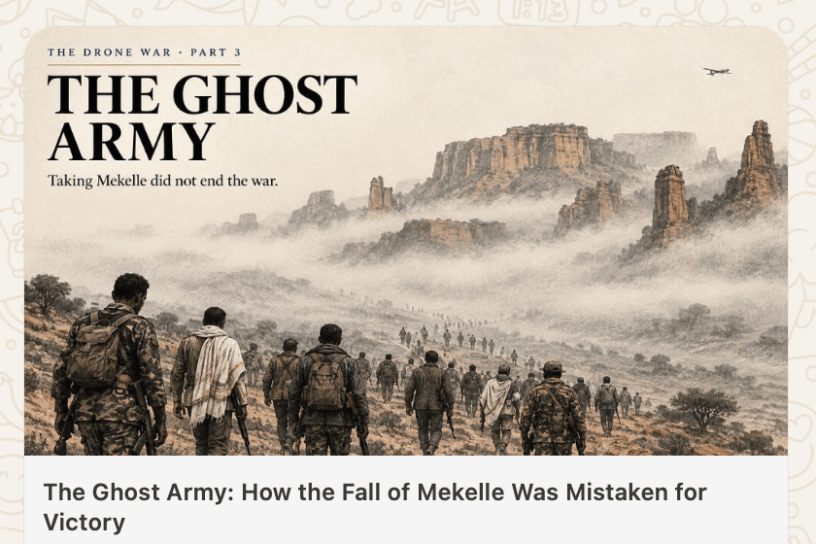
Ethiopia’s army retook Tigray’s cities almost without a fight. Occupying territory is not defeating an army, and neither confers the right to govern.
Source: ሐተታ Hatata
Oct 20, 2026
Mekelle fell on a Saturday, and almost no one fought for it. On 3 October federal troops took the airport on the city’s southern edge; by the end of the day, they and the Tigray Peace Force, a federally backed Tigrayan militia, were in the center. AFP reported that they entered “without a fight, after TPLF leaders and fighters abandoned the city.”
Residents had watched fighters with light weapons walk out, some of them on foot. Within a day looters had stripped government offices and the warehouses of the regional disaster agency. The TPLF, for its part, announced that it had “temporarily moved out of Mekelle” and that the regional government would “operate from somewhere else.”
Thanks for reading! Subscribe for free to receive new posts and support my work.Subscribe
Mekelle had fallen. The army that held it had not been destroyed.
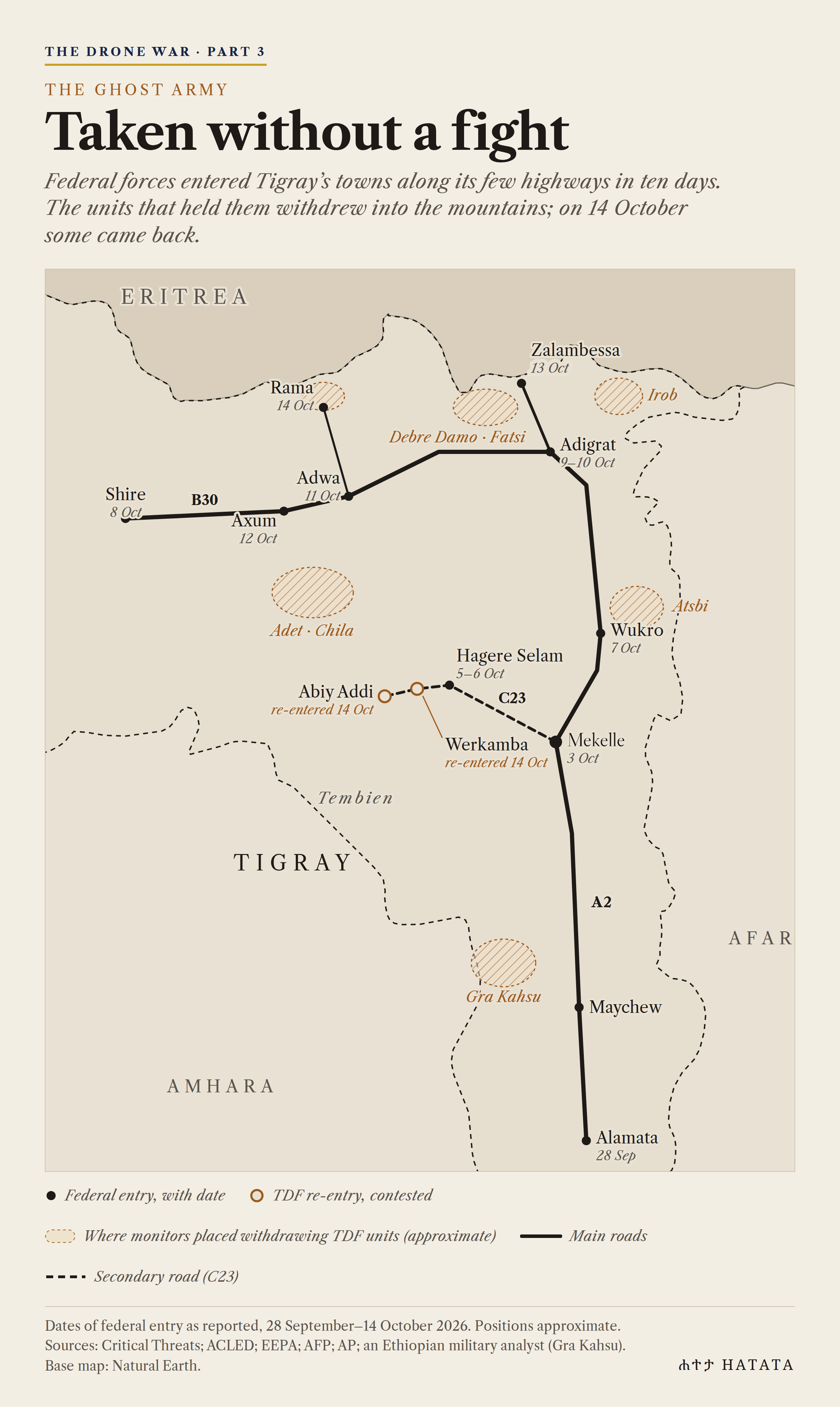
What followed had the look of a rout. For ten days the same scene repeated itself along Tigray’s few highways: at Wukro and then Adigrat on the A2, which federal columns entered overnight “without resistance”; at Shire in the west; at Hagere Selam, Abiy Addi and Werkamba in the central mountains; at Adwa and then Axum, until by 13 October federal tanks were moving toward Zalambessa on the Eritrean border. Crisis Group described an army regaining “control of major towns with a minimum of fighting.”
A minimum of fighting is the puzzle. A city taken without a fight is a city whose defenders went somewhere. On 11 October Getachew Reda, by then speaking for the federal side, declared the war over. Three days later federal forces pulled out of Abiy Addi and Werkamba, in the Tembien highlands west of Mekelle, and Tigray Defense Forces (TDF) units walked back in.
The federal army plainly won ground. What it did not do was end the opposing force’s capacity to fight, and in taking the towns it redistributed its problem rather than solving it: every new garrison needed supply and reinforcement while surviving TDF units contested the interior and Amhara Fano National Movement (Fano) fighters struck the roads behind the advance. The map registered the expansion; it did not register the burden of sustaining it. Beneath that lies a second question that no battlefield can answer, for even a decisive military defeat would leave unresolved who governs Tigray, with whose consent, and on what terms.
The Army That Was Not There
Call it a ghost army. The TDF did not vanish; it dropped off the map that most war reporting reads, a map of towns, airports and highways, and went on fighting on another. And what haunts a war of this kind is less the army that leaves the towns than the reasons people took up arms in the first place, which do not leave with it.
Much of what it did is on the record. Before the city fell, the TPLF had, in the words of Critical Threats, “pre-emptively withdrawn from Mekele,” abandoning the 40-kilometer stretch of the A2 between Adi Gudom and the capital. The pattern held up the highway. At Wukro, Shire, Adigrat and Adwa, TDF units pulled out as federal columns approached, for mountain positions off the road or toward the border; when Axum fell, monitors at ACLED and EEPA placed them in “the mountainous rural areas of Adet and Chila.” It had begun weeks earlier in the south, where, by an Ethiopian military analyst’s account, the loss of Waja sent TDF units back toward the Gra Kahsu mountains.
The retreat mixed surviving formations, abandoned posts and fighters going home, and no one has yet counted the balance. Crisis Group reports that the advance compelled “most TPLF units to retreat to the countryside,” and that the TPLF “says it has now regrouped for a new phase of combat.” Two days before Mekelle fell, the TPLF chairman, Debretsion Gebremichael, had already described the war he meant to fight. “We operate under a strategy to strike the enemy wherever we choose,” he said in a video message reported by AFP.
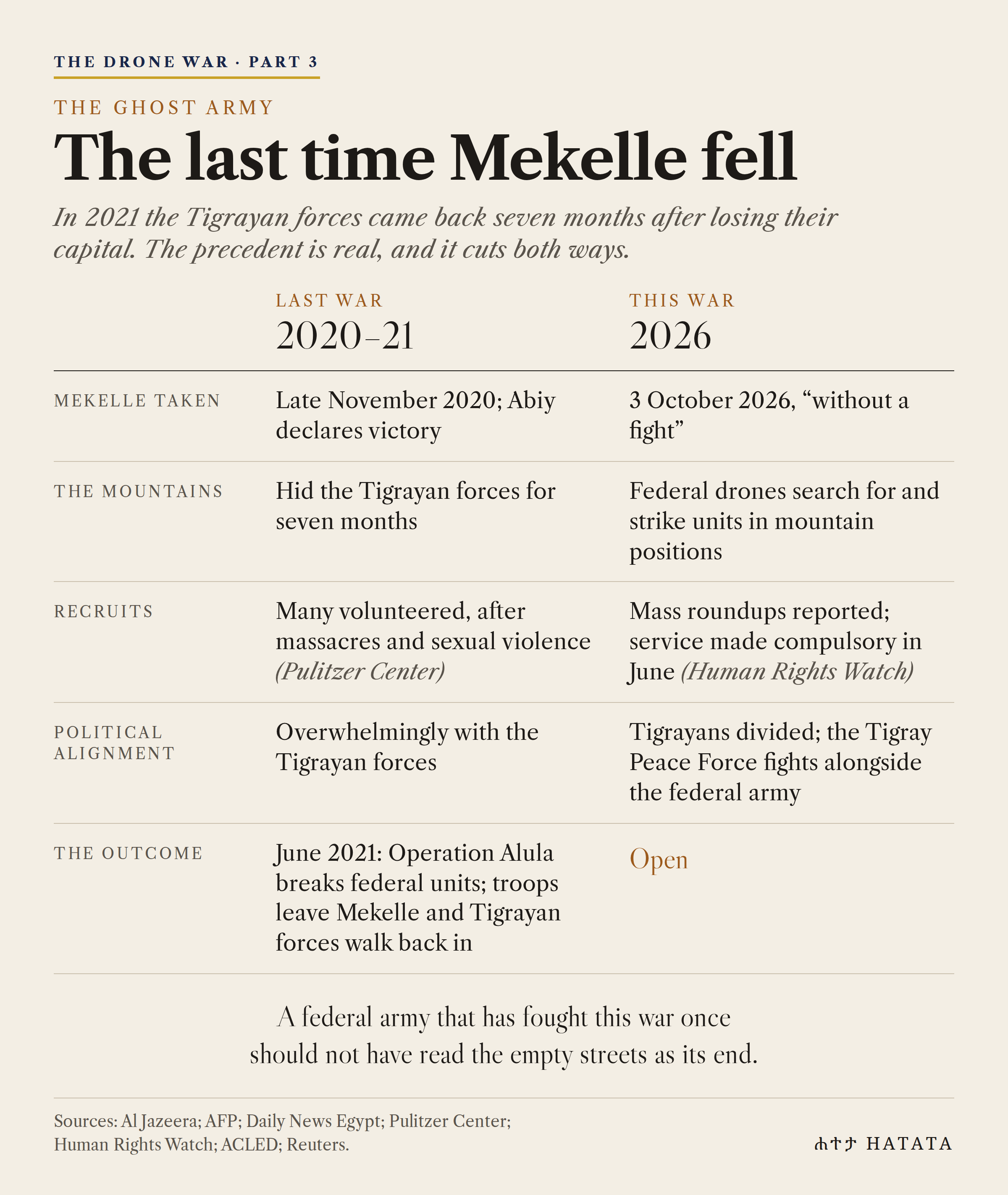
Tigray has lived this before, more than once. The TPLF was founded in 1975 in the lowlands of Dedebit and fought the Derg from the countryside for fourteen years before its forces entered Mekelle in 1989; it learned its war in the mountains long before it governed from a capital.
Federal troops entered Mekelle in late November 2020 and Abiy Ahmed declared victory. For seven months the Tigrayan forces held no large town; their leaders said they were “regrouping in remote rural areas.” They were doing more than regrouping. Out of the countryside came a campaign of ambush and attrition, and in June 2021 an offensive the Tigrayans named Operation Alula broke federal units in the field within days. Abiy himself described troops set upon from the rear: “many people suddenly came from behind and attacked and massacred the army.”
On 28 June federal soldiers and Abiy’s interim administration left Mekelle, the prime minister explaining that the city had “lost its center of gravity”; Crisis Group’s William Davison called the official explanations face-saving (AFP). Tigrayan forces walked back in, and within days thousands of captured federal soldiers were marched through the city’s streets; Debretsion claimed more than 6,000 prisoners (Daily News Egypt). An army that had held no town for seven months had not been absent. It had been fighting where the map was not looking.
The TDF did not vanish; it dropped off the map that most war reporting reads, a map of towns, airports and highways, and went on fighting on another.
Terrain alone did not bring them back. In those seven months, as Ethiopian and Eritrean forces killed civilians and used sexual violence across the region, the Tigrayan forces grew. In a study of Tigray’s female veterans, one, Asmeret, joined, in the researchers’ words, “because she was determined not to be the victim of similar violations”; another, Mihret, was turned away three times before she was accepted. That history gave “temporarily” in the TPLF’s October statement a resonance it would not otherwise have had.
The Highway and the Landscape
Tigray is a plateau cut by gorges and crossed by a few roads, and the federal advance followed them: the A2, the spine of the last war and of this one, north from Alamata through Mekelle to Adigrat, and the roads that branch from it to the border at Zalambessa and west to Axum and Shire. West of Mekelle the C23 climbs into the Tembien massif, country that Critical Threats calls the TPLF’s “historical guerrilla sanctuaries.”
A conventional army is built for those roads. Mechanized columns, heavy artillery and drones overhead move fast along tarmac, and on the A2 north of Mekelle the federal army advanced “without resistance.”
But four different things can be won in a war like this. An army can occupy a city. It can control a highway. It can defeat the force opposing it. And it can hold the landscape that force retreats into. By mid-October the federal army occupied the principal towns and had advanced along the main roads almost everywhere outside the disputed west; entering the towns did not secure the connections between them. The advance was documented. The destruction of the opposing army was not: no monitor reported the mass surrenders, captured formations or destroyed units that would mark the third. The fourth was what the fighting in Tembien was about.
The four are easily mistaken for a single victory, yet each leans on another it cannot guarantee. A garrison in Axum lives off a road it may not securely hold. A force that has lost every town can still cut that road without being able to govern a single one of them. And an administration can open its offices under armed protection without having settled its right to rule. Nor does the map divide neatly into federal roads and Tigrayan mountains; both sides hold pieces of each kind of control, unevenly and at the edges. The war turns on how far one kind of control can be converted into the next and on where the conversion breaks down, a lesson armies relearn wherever they mistake the map for the war.
The farther the army went, the more road it had to guard. The road from Alamata to Zalambessa alone runs more than 300 kilometers; a longer supply line means more garrisons to hold and more convoys to protect, and the same army is holding the Afar front against the Alliance for Survival and fighting Fano in Amhara. Federal commanders did not treat the mountains as empty. When the column on the A2 halted outside Wukro from 5 to 7 October, Critical Threats judged the pause was likely meant to guard against a TPLF counterattack or flanking move. “We shouldn’t imagine that this conflict is completely over just because the TPLF has lost Mekelle,” Crisis Group’s Magnus Taylor told AP.
Those roads are also attacked from behind. On 3 October, as federal forces entered Mekelle, fighters of the Amhara Fano National Movement captured Wurgessa on the A2, the main road between Addis Ababa and Mekelle, some 30 miles south of Woldia; attacks around Mekane Selam cut the B21, Amhara’s main east-west highway, though control of the town stayed contested. Fano, Critical Threats concluded, had “disrupted key federal supply lines into Tigray via the Amhara region.” By mid-October Fano had taken Wegere in North Shewa and was fighting federal forces in Delanta, about 20 miles west of Woldia (Critical Threats). None of this reversed the advance inside Tigray. It pressed on the connections that sustain it, which is a different measure of whether an army holds what it has taken.
A force that has lost every town can still cut that road without being able to govern a single one of them. And an administration can open its offices under armed protection without having settled its right to rule.
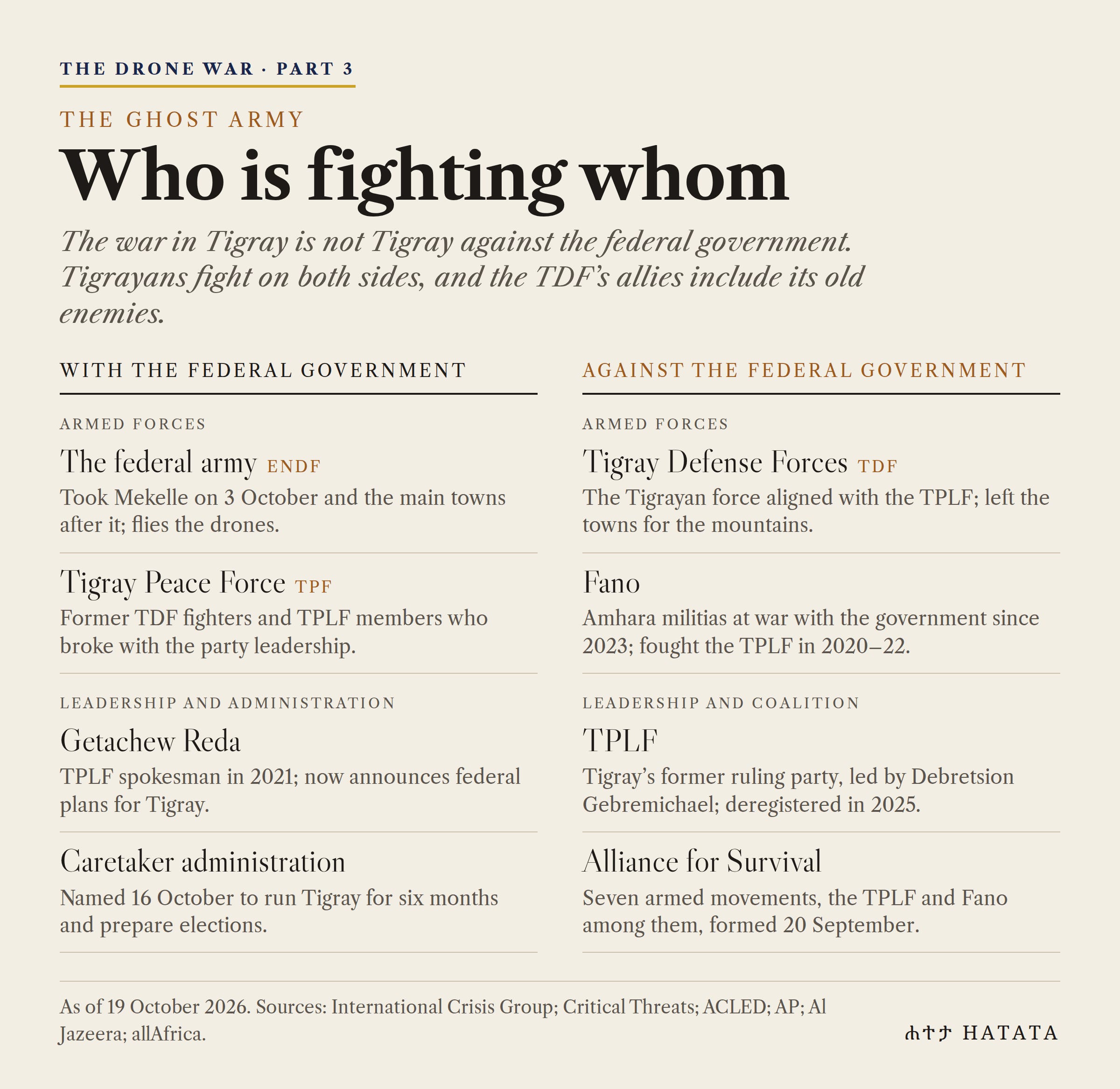
The Alliance for Survival is united more firmly against the government than around the settlement that would replace it. Fano fought beside federal troops against the TPLF in 2020–22, and Western Tigray still divides them. Yet by late September Al Jazeera was describing Fano fighters who once fought alongside federal troops “now fighting alongside the TPLF” (Al Jazeera), and ACLED recorded federal forces, Fano and the TDF fighting across North Wollo and Wag Hamra at the same time (ACLED).
Nothing on the record shows a joint command. The two forces can burden the federal army without one. While the TDF contests the mountains inside Tigray, Fano fights in Amhara and presses on the roads that feed the advance into Tigray, and one army must garrison towns, hold roads and secure its rear all at once. Two forces that cannot agree on who owns Wolkait can still impose a common burden on the federal army, counted in roads to secure and troops tied down.
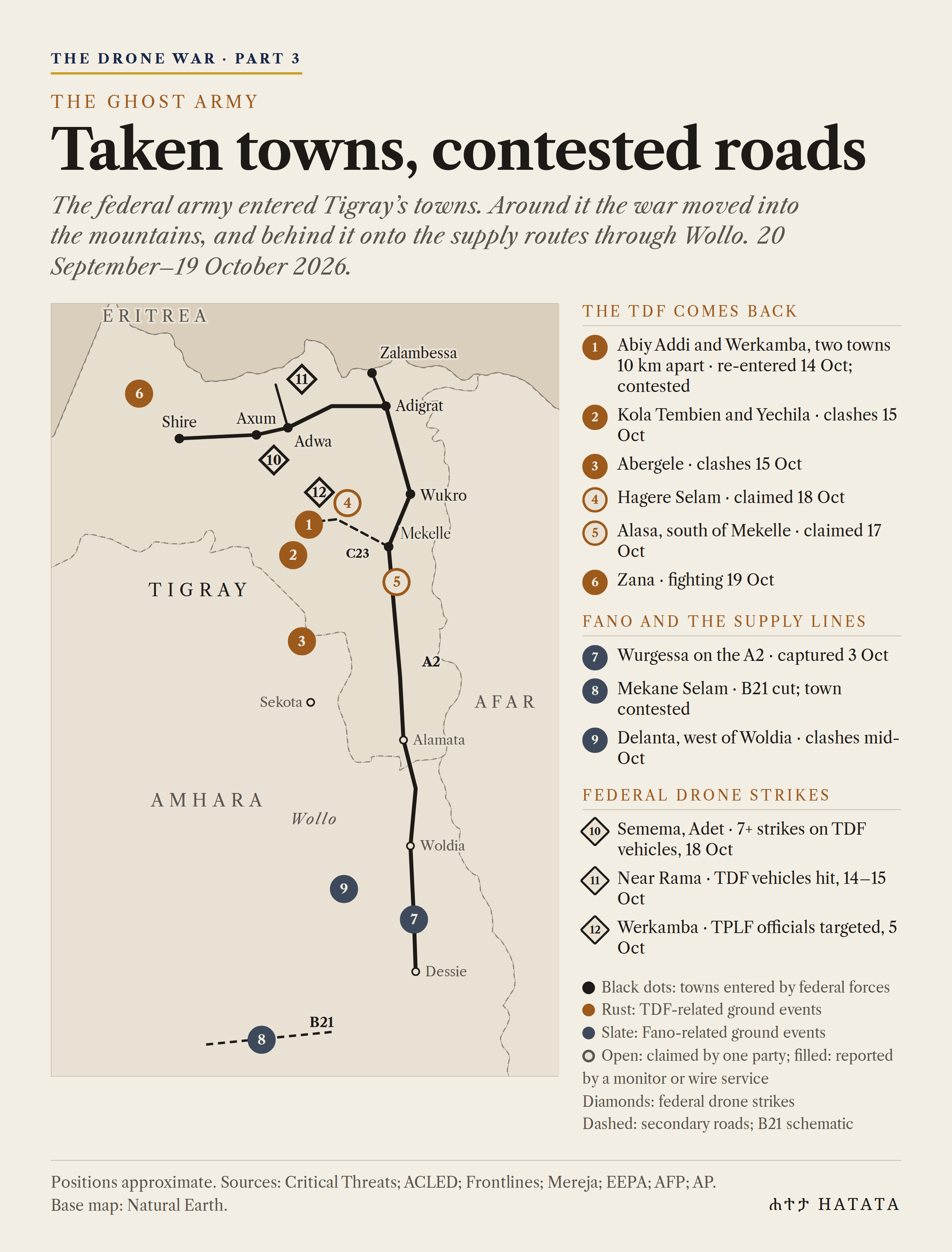
But the countryside is a less certain refuge than it was in 2021. In 2021 the federal army’s drones arrived late, after the Tigrayan forces had already come down from the mountains; this time they were overhead from the first week. On 5 October federal drones struck Werkamba, where TPLF officials were believed to be hiding, and in mid-October, by ACLED’s record, they hit TDF vehicles near Rama and, reportedly, a cattle ranch near Abiy Addi. Of the 40 drone and air strikes the monitor Frontlines logged between 20 September and 19 October, 21 fell in Tigray, among them federal strikes on a church in Semema, a school and health center in Ahsea and a displacement camp in Sheraro. The phone and internet blackout that began on 24 September was, according to four sources who spoke to Reuters, ordered by the TPLF itself, to keep federal drones from homing in on phone signals.
The drone war also runs the other way. In late September the Alliance’s strikes reportedly reached air bases at Bishoftu, Kombolcha and Semera, killing a senior pilot at Bishoftu, and suspected drones hit Addis Ababa, including the army’s headquarters, overnight on 30 September (Critical Threats). Since losing Mekelle, the TPLF has said it will act against flights using the city’s airport, which it believes carries military traffic (EEPA).
The strikes show why the mountains cannot be counted as safe ground merely because no federal soldier stands on them. But the ability to hit a place is not the ability to hold it, and the distinction cuts both ways. Federal drones reach villages the army has never entered; drones attributed to the Alliance reached Bishoftu, and suspected drones the army’s headquarters in Addis Ababa, without bringing their senders any closer to holding either. Drones give the state eyes over the countryside and the means to kill what they see, but they cannot garrison a village or tell a fighter from a farmer with certainty.
Was It a Trap?
The tempting reading is that Mekelle was bait: an empty city offered to draw a heavy army up into country that favors the defender. Nothing on the record shows that it was, and the case against it is substantial. Three explanations compete.
The first is that the TDF was beaten and fell back because it had no choice. This one has real support. Under the Pretoria agreement, Crisis Group notes, Tigray’s forces surrendered much of their heavy weaponry, and more than 75,000 fighters were demobilized “from a force that numbered around 250,000-300,000 at its height”; what remains has limited air defenses against an air force that has spent five years learning to use drones. Those are figures for past mobilization and demobilization, not a count of the army now fighting.
In Mekelle, a resident told Reuters, fighters were “abandoning their posts and heading home.” Days later former fighters were lining up in the city to register for demobilization, and on 3 October federal drones had struck Adigrat University, where wounded TDF and Afar fighters from Mekelle had been taken.
There is a deeper problem for the guerrilla reading too. In 2021 the Tigrayan forces regrouped among a population that was overwhelmingly theirs. In 2026 the federal army enters Tigrayan towns alongside Tigrayans: the Tigray Peace Force, formed by former TDF fighters and TPLF members after the party split, has fought alongside it in many of the entries. Mountain refuge depends on the villages below, and Tigray’s political split has made those villages a contested military resource.
The second explanation is a deliberate withdrawal, made to save fighters and spare cities. This has support as well. The TPLF said it left Mekelle to prevent its destruction. Its withdrawals from Shire, Adigrat and Adwa happened before federal troops arrived, not under assault. ACLED located the leadership in Ahferom district within days. And Debretsion announced a war of choosing where to strike before he lost the capital, not after. A strategy named before the capital fell, and withdrawals made ahead of the federal columns, are the conduct of a force husbanding its strength, not one driven from the field.
The strongest explanation combines military pressure with adaptation: a retreat under real pressure that left surviving units where the federal army is weakest, in positions from which they could keep fighting. Whatever the original plan, the conduct reveals a pattern: give up towns rather than accept decisive battle for them, preserve what units survive, re-enter selectively, keep moving under the drones, and let allies press on the roads. It needs no master plan, only that units left the roads before they were destroyed on them and that the army behind them had to spread out to hold what it had taken. Whether Mekelle was intended as bait matters less than what the withdrawal allowed the surviving units to do.
Preserving fighters, though, does not by itself preserve what an insurgency lives on. The countryside an army withdraws into is made of villages, and the people in them can feed a unit, hide it, avoid it, turn away its recruiters or tell the other side where it sleeps. In 2021 the Tigrayan forces could count on most of them. This year the record shows conscription resisted, former fighters queuing to demobilize and Tigrayans fighting in the Tigray Peace Force.
ሐተታ Hatata reads the Persian Gulf, the Red Sea and the Horn of Africa through evidence, history and political economy.Subscribe
The Ghost Returns
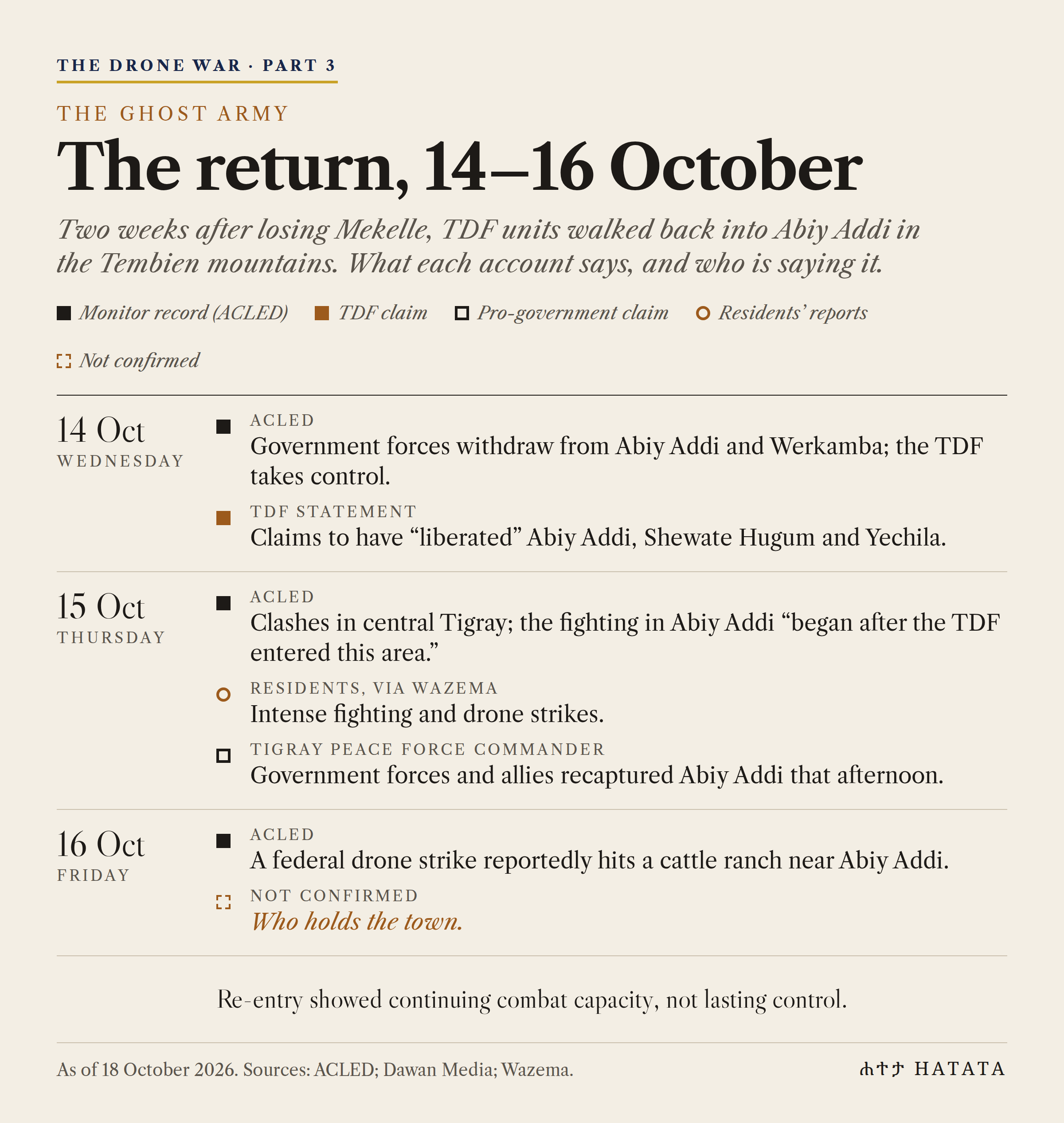
On 14 October, ACLED reported that government forces had withdrawn from Abiy Addi and Werkamba and that the TDF had taken control. The same day the TDF posted a statement claiming to have “liberated” Abiy Addi, Shewate Hugum and Yechila from the government’s forces (Dawan Media).
operations to disarm fighters in three valleys are not what an army mounts against a force it has destroyed.
On 15 October, ACLED reported clashes in central Tigray, saying the fighting in Abiy Addi “began after the TDF entered this area” (ACLED), and residents described intense fighting and drone strikes (Wazema). A Tigray Peace Force commander said government forces and their allies had recaptured Abiy Addi that afternoon (Dawan Media).
ACLED records the re-entry and the fighting that followed; who held the town by the 16th remained disputed.
The fighting did not stay in Abiy Addi. Drawing on DW Amharic and Wazema, Critical Threats reported clashes involving drones in Kola Tembien and around Shewate Hugum and Yechila on 15 October, and in Abergele, 50 miles to the south. On 17 October, by ACLED’s record, large federal columns of troops and weapons left Rama for Adwa; on the 18th federal drones struck TDF vehicles in Semema, in Adet, at least seven times; on the 19th fighting was reported in Zana, in the northwest.
Tigrayan forces claimed Hagere Selam, on the road west of Mekelle, and Alasa, south of the city; neither claim has been independently confirmed (Frontlines, Mereja). The Tigray Peace Force said the TPLF’s core leadership had crossed into Eritrea. And on 19 October Getachew Reda announced that the army and the Tigray Peace Force would mount operations in the Tembien, Adet and Zana valleys to disarm the fighters who remained (Frontlines).
The claims from the Tigrayan side have since grown larger. On 20 October Anadolu reported a video briefing by the TPLF official Negash Hiluf, carried by Tigray Media Corporation, in which he said Tigrayan forces had killed 1,511 federal soldiers, wounded 1,050 and killed 11 members of the Tigray Peace Force near Mirena in central Tigray on 17 and 18 October, as government troops tried to advance toward Adet. Anadolu could not verify the figures, and the federal government did not comment. The same report said federal troops had withdrawn from Adwa and Rama, near the Eritrean border, after TPLF attacks. Adwa sits on the B30, the road from Shire through Axum that the federal army took on 11 and 12 October; a pullback there, if confirmed, would extend the reported federal withdrawals beyond Tembien to the Shire–Axum–Adwa corridor.
Tigrayan-sourced accounts circulating on YouTube go further. They relay TDF claims of more than 3,000 federal casualties, about 1,500 of them wounded, on the Axum–Shire front, and describe a federal collapse in the northwest. They also report large-scale surrenders in Axum and Adwa, a compromised Sekota route through Amhara and Eritrean reinforcement near Badme. Commentary citing TDF sources calls the approach an asymmetric, mobile “war of suffocation” against federal supply lines rather than a full-scale offensive (war of suffocation). None of this has been independently confirmed.
Within two weeks of losing its capital, the TDF still had organized units able to re-enter a town 96 kilometers from Mekelle, fight across central Tigray and move vehicles that federal drones were still hunting on 18 October. The federal side’s own plans acknowledge as much: operations to disarm fighters in three valleys are not what an army mounts against a force it has destroyed. Survival is established. The scale of federal losses remains uncertain, and the reported interruptions have yet to prove durable. Whether the TDF can sustain them will become clearer over the coming weeks, as federal forces try to supply, reinforce and hold their positions.
An army that holds towns at the end of long roads depends on those roads to bring soldiers and munitions in and to carry the wounded out. If fighting has interrupted movement along the Shire–Axum road, as the TDF claims imply, and the Sekota route through Amhara has been compromised, as TDF sources claim, the question would extend beyond supply and reinforcement to evacuation: how wounded soldiers reach treatment. The TPLF’s threat against flights from Mekelle’s airport adds another uncertainty. Neither the federal army’s evacuation capacity nor the scale of unmet medical need has yet been established. The latest fighting brings the burden of sustaining the advance, the burden the map never registered, into sharper view.
A war that moves between towns and countryside spreads danger beyond any recognizable front: villages become places where armed units seek shelter, opposing forces seek intelligence, and civilians bear the consequences of both. It arrives in a region already on the edge of famine. By the regional disaster agency’s count, 3.9 million people, more than half of Tigray, needed emergency food aid in September, and about 3.2 million of them were getting none; some 900,000 displaced people live in 31 camps, and “many households experienced complete crop failure.”
The machinery of ordinary life has been cut as well. Commercial Bank of Ethiopia accounts opened in Tigray have been frozen unless their holders appear in person at designated branches in the capital, and the communications blackout shut down the mobile money that had replaced scarce cash; Mekelle was cut off from the world for ten days. By 1 October, MSF had counted more than 720 wounded since 22 September in the hospitals it supports at Korem, Alamata and Shire.
People farm and live in those mountains, and they bear the costs of the campaign. This is where people meet authority: whether money can be drawn, food delivered, a hospital reached, a recruiter refused. Any administration’s claim to govern Tigray will be tested there, not only in the offices it occupies.
What an Army Is Not
Suppose the federal army does finish the job: clears Tembien, takes Rama, pushes the last TDF units across the border or destroys them. It would have defeated an army. It would not, by itself, have settled what that army says it fights over. The last war left Tigray with what Human Rights Watch called an “effective siege,” a finding by UN investigators of reasonable grounds to believe that the federal government used starvation as a method of warfare, and an African Union mediator’s estimate of about 600,000 dead.
Pretoria stopped the shooting and left the rest. As Crisis Group has documented, Western Tigray is still held by Amhara forces, tens of thousands of Tigrayans displaced from it have not gone home, Eritrean troops never fully withdrew, and in May 2025 the TPLF was deregistered as a party.
Underneath sits the oldest question, how far Tigray governs itself inside the federation. In September 2020 Tigray held its own regional election after Addis Ababa postponed the national vote, and federal officials called it “null and void.” Two months later the war began. None of these is a military objective, and none was settled when Mekelle fell.
But a grievance is not an army, and the TDF is not Tigray. In 2020–21 many recruits came of their own accord. This year Human Rights Watch documented something else: from late April, Tigray’s authorities, the TDF, police and militia rounded up former fighters, men and boys as young as 15 from streets, markets and gold-mining sites, and a June proclamation made service compulsory. “All of us opposed the decision,” a miner in Kola Tembien said. The party denied it, saying those defending the region did so voluntarily. Crisis Group judged the conscription drive “widely unpopular” and public opinion before the fighting “largely anti-war.” In October former fighters lined up in Mekelle to demobilize, and Tigrayans of the Tigray Peace Force were fighting on the federal side.
Tigray’s own politics have been split since March 2025, when, by International IDEA’s account, Getachew Reda, then head of the interim administration, suspended three senior TDF commanders and Debretsion’s faction took over Mekelle’s offices around him. By April he had been forced out to Addis Ababa; this May the TPLF ousted his successor, Tadesse Werede, restored Tigray’s pre-war regional council and made Debretsion its president (Crisis Group). The grievances are widely held. The TPLF’s claim to speak for them is contested by Tigrayans themselves. To take Tigray’s grievances seriously is not to endorse the TPLF, excuse the TDF, or assume Tigrayans agree on their future.
The political question, then, is who supports these organizations, who submits to them and who resists. Grievance did not automatically produce fighters this year; the TDF had to conscript some of them. Armed organizations recruit through those grievances, invoke them to justify their campaigns and compete over who speaks for them. Coercion can clear the streets of armed opposition, but it cannot manufacture consent.
Who Governs Tigray?
The federal plan was laid out on 11 October by Getachew Reda. Tigray would sit under a six-month federal command post meant to “make Tigray governable,” with security in the hands of the army and the Tigray Peace Force, elections under the national election board, and a pledge to return the displaced to Western Tigray, a pledge that has gone unmet since Pretoria. The same day the TPLF’s deputy chairman, Amanuel Assefa, promised a “miraculous counteroffensive.”
Addis Ababa has put an election inside a command post, and the TPLF has answered a dispute over who governs with a promise to fight.
“Governable” is a revealing word. It sounds like a practical condition, restored when offices reopen and the roads become passable; it also raises the question of governable by whom. An administration can issue orders long before it has settled its right to issue them. The TDF’s word for walking back into Abiy Addi, “liberated,” settles the same question just as quickly, in the other direction.
The federal argument is straightforward: elections require security, and an armed organization that rejects the new administration and promises a counteroffensive can obstruct one. But when the forces securing an election also police the campaign, security becomes part of the political contest. The TPLF faces its own version of the problem. What makes an armed organization’s claim to speak for Tigray representative when some of the people it says it defends resist its recruiters or fight on the other side? Each side is answering a political question on military terms: Addis Ababa has put an election inside a command post, and the TPLF has answered a dispute over who governs with a promise to fight.
On 16 October Abiy named a six-month caretaker administration to restore services, return the displaced and prepare elections. The next day the TPLF called it a “Prosperity structure” whose decisions would have “no legality or enforceability.”
The appointment does not settle the administration’s legitimacy, and the TPLF’s rejection does not settle its own right to govern. Offices can reopen under military protection; governments at war often need it. The political test is whether people can organize, campaign, move and refuse recruiters without punishment, whether they can challenge the administration without confronting the forces that installed it. The same test applies to the TPLF. Getachew Reda was the spokesman for the forces that drove out a federal administration in 2021. Now he explains the terms of federal rule.
The ghost in this war is the army that leaves the highway and comes back from the mountains, and behind it the political question that taking Mekelle did not answer: who governs Tigray, with whose consent, and on what terms with the federal state. The same question stands, in other forms, in Amhara, Afar, Oromia and across Ethiopia. The federal army can take a town. The TDF can make holding it costly. Neither achievement establishes who has the right to govern. Until Tigrayans can contest that question without an army deciding the terms, taking Mekelle will remain a military event mistaken for a political settlement.
This is Part 3 of a four-part ሐተታ Hatata series on Ethiopia’s drone war. Part 1 covered the Alliance’s strikes on the government’s air bases; Part 2, how Sudan’s war runs through Ethiopian airfields. Part 4 turns to life beneath the drones. In Amhara, Tigray and Oromia, people still have to go to market, send children to school and find somewhere to shelter. What kind of peace is possible when a state can attack at any time, without a battle, and what happens when the moral and legal restraints on killing civilians cease to bind those who order the strikes?
Reporting through 20 October 2026.
Sources
1. AFP. Federal forces enter Mekelle. Kuwait Times, 5 October 2026.
2. Associated Press. Tigray’s leaders leave Mekelle. KIRO 7, 4 October 2026.
3. The New Humanitarian. War and worsening hunger in Tigray. 8 October 2026.
4. Al Jazeera. Federal forces retake Mekelle. 5 October 2026.
5. Critical Threats. Ethiopia War Security Review. 9 October 2026.
6. Critical Threats. Ethiopia War Security Review. 13 October 2026.
7. International Crisis Group. Containing the New War in Northern Ethiopia. 15 October 2026.
8. UMD Media. Getachew Reda’s command-post and election plan. 11 October 2026.
9. ACLED. Ethiopia Alerts archive. October 2026.
10. Critical Threats. Ethiopia War Security Review. 6 October 2026.
11. EEPA. Federal control of northwestern and central Tigray towns. Situation report, 15 October 2026.
12. An Ethiopian military analyst. The northern war becomes a war of attrition. Martin Plaut, 30 September 2026.
13. AFP. Tigrayan forces withdraw from Mekelle. Deccan Chronicle, 3 October 2026.
14. AFP. Mekelle’s fall and the next phase of war. Ahram Online, 2 July 2021.
15. Al Jazeera. Tigrayan forces return to Mekelle. 29 June 2021.
16. Daily News Egypt. Captured federal soldiers in Mekelle. 3 July 2021.
17. Mehret Okubay Berehe and Hilary Matfess. Tigray’s female veterans. Pulitzer Center, 28 August 2025.
18. Wazema. Fighting for Tembien. 16 October 2026.
19. Associated Press. Caretaker government and ex-fighter demobilization. KIRO 7, 16 October 2026.
20. Critical Threats. Ethiopia War Security Review. 16 October 2026.
21. Al Jazeera. Renewed fighting and the risk of wider war. 26 September 2026.
22. Frontlines. Drone and airstrike records, 20 September–19 October 2026. Updated 19 October 2026.
23. Reuters. The communications blackout in northern Ethiopia. 25 September 2026.
24. Critical Threats. Ethiopia War Security Review. 2 October 2026.
25. EEPA. Caretaker administration and reported recapture of Axum. Situation report, 19 October 2026.
26. Al Jazeera. The federal advance and Tigrayan retreat. 3 October 2026.
27. Dawan Media. TPLF claims the recapture of Abiy Addi. 15 October 2026.
28. ACLED. Conflict in Ethiopia. Updated 19 October 2026.
29. Frontlines. Reported TDF capture of Hagere Selam. 18 October 2026.
30. Mereja. Federal–TDF fighting. 18 October 2026.
31. Frontlines. Getachew Reda on operations in Tembien, Adet and Zana. 19 October 2026.
32. Anadolu. TPLF claims heavy federal losses near Mirena. 20 October 2026.
33. Latest Researches & News. TDF claims on the Axum–Shire front. YouTube, 19 October 2026.
34. Latest Researches & News. The northwestern Tigray front. YouTube, 19 October 2026.
35. Latest Researches & News. Semema, Adet, Badme and Sekota. YouTube, 20 October 2026.
36. Military and Foreign Affairs Network. Tigray’s war of suffocation. YouTube, 18 October 2026.
37. Kulu Media. Access restrictions on Tigray bank accounts. 28 September 2026.
38. Dawan Media. MSF reports more than 720 wounded. 1 October 2026.
39. Human Rights Watch. World Report 2022: Ethiopia. January 2022.
40. UN Human Rights Council. Commission findings on crimes against humanity in Tigray. 22 September 2022.
41. The National. The AU envoy’s estimate of Tigray’s war dead. 16 January 2023.
42. International Crisis Group. Ethiopia, Eritrea and Tigray: A Powder Keg in the Horn of Africa. 18 February 2026.
43. AFP. Tigray’s disputed regional election. Ahram Online, 9 September 2020.
44. Human Rights Watch. Forced recruitment by Tigray’s authorities. 6 July 2026.
45. International IDEA. Ethiopia Democracy Tracker. March 2025.
46. Reuters. Abiy appoints a new Tigray administration. CNBC Africa, 16 October 2026.
47. Anadolu. TPLF rejects the new administration. 17 October 2026.
48. Al Jazeera. Federal gains and claims of Eritrean losses. 15 October 2026.

