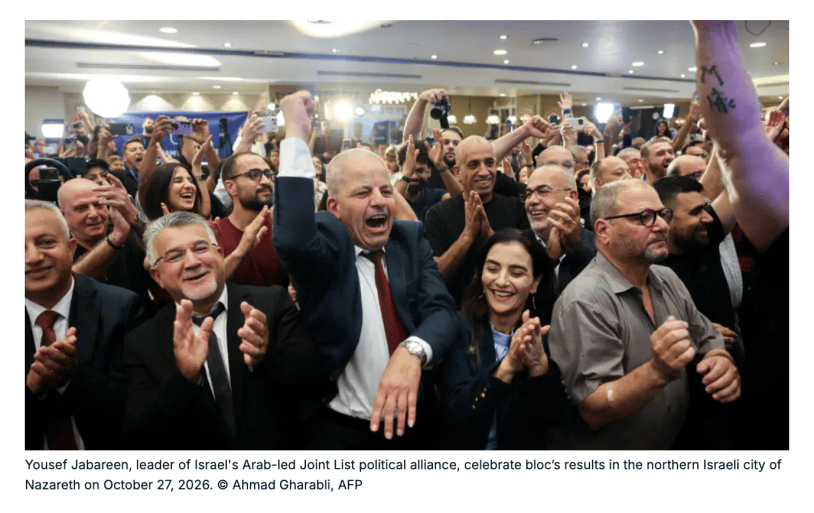
I make no claims to expertise in this field (although I have visited and reported from Israel, Gaza and Lebanon in years gone by) but the current election is fascinating.
The story is far more complex than most outsiders understand. Let’s not forget that Arabs came out in record numbers and won 19 seats in the 120 seat parliament. They will be important as negotiations proceed to form the next government.
The far left and far right in Europe and the USA see the story in very simple terms of right and wrong, Jews and Arabs. The reality is far more nuanced and difficult to understand.
I am told by Israeli friends that the Israeli Arabs (or Palestinians – how should one best describe them?) concentrate on their lives in Israel rather than what is happening in Gaza. Hardly surprising, perhaps.
The other key point for me is how some Jews and Arabs cross over the divide.
Three examples
First. there are examples of Jews who are members of Ra’am – which is a mainly Bedouin party. Yoav Segalovitz is one. He is by no means on the left.
He served in the Paratroopers Brigade during his national service in the Israel Defense Forces. And he was Deputy Minister of National Security between 2021 and 2022. He is now number 2 on Ra’am’s election list and might be in the next government.
Voter turnout in Rahat, Israel’s largest Bedouin city, approached 80% on Election Day, up from 60.6% in the previous election, amid a surge in participation across communities in the Negev.
Second, Some Arabs also support Zionist parties.
Yoseph Haddad is one. A Christian Palestinian, Haddad volunteered to join the Israeli Defence Force in 2003. He said he was motivated to do sy by an atrocity: the Maxim restaurant suicide bombing that killed 21 Israelis, including several Israeli Arabs. At his request, he was accepted into another elite unit, the Golani Brigade and became a commander. For his work during the Gaza war, the Zionist Council in Israel recognized him as one of 16 “Heroes of the Home Front” in 2024.
In the current election Haddad was on People of Israel party list, behind chairman Brig.-Gen. (res.) Ofer Winter. The right-wing party endorsed Prime Minister Benjamin Netanyahu.
The third is the fact that the Druze community in the Golan – once part of Syria and now claimed by Israel – began voting in significant numbers for the first time.
The Druze are Arabs, with the faith originally developing from the Ismā‘īli branch of Shiʿa Islam, although members of the Druze community do not now identify as Muslims. Following the fall of the Assad government in Syria, the Druze community came under attack. In March 2025 they were massacred – with between 1,000 and 2,000 being killed. It was Israel that intervened, with direct military action. On 30 April, Prime Minister of Israel Benjamin Netanyahu stated that Israeli Defense Forces had conducted a strike against what he described as an “extremist group” ready to attack the “Druze population south of Damascus.”
The Druze community in the Golan, who had been loyal to Syria, began moving towards loyalty to Israel. As Ha’aretz reported:
In just two years, the rate of Israeli citizenship recipients rose from about 20 percent to 44 percent, which spurred significant political participation on Election Day. Thus, after only a few ballot boxes were first placed in the villages for the Knesset elections in 2022, their number quadrupled this week. The voting rate also increased accordingly: if in 2022 only about 20 percent of citizens voted, then in the elections held this week, an average of about 45 percent of eligible voters participated.
Avigdor Lieberman, leader of the right-wing opposition party Yisrael Beiteinu, won a majority of the vote. He is now in a position to possibly play a decisive role in shaping the next Israeli government – either backing the Eisenkot opposition, or shifting to the Netanyahu camp.
Liberman made clear on Friday that his party would not join a coalition that includes Arab parties, despite benefitting from Arab – Druze – votes.
A comment
This – from an opinion article in Ha’aretz – is a useful perspective.
“Peace will come when the Arabs will love their children more than they hate us,” goes the saying attributed to former Israeli Prime Minister Golda Meir. It is a comforting sentence for anyone who wants to believe that responsibility for this country’s future rests permanently with someone else. Jewish parents’ love for their children is taken for granted, while the love of Arab parents is assumed to be inferior and insufficient.
After Tuesday’s election, Jewish Israeli leaders and the public that supports them should answer the question they have so readily directed at us: Do you love your children more than you hate Arabs? If the question sounds offensive, consider how comfortably its premise has been applied to generations of Palestinian parents.
Israeli politics is a mad, mad, mad world in many ways – not so very different from the complexities of politics anywhere else.
For clarity, these are the terms that opposition block leader, Gadi Eisenkot laid out after the election results were declared.
A few things from me to you, my Israeli brothers and sisters, ahead of the coming days:
The vote count has concluded and the elections are over. No matter how you look at the numbers, a majority of Israeli citizens, by a margin of more than half a million votes, voted against the government of October 7 and the evasion, and for change—a majority among all Israeli citizens, and a majority among the serving Zionist public.
I defined these elections over the past year as the most fateful in Israel’s history, and their results are clear, even though there are those working to cast doubt on them. I promised to reconnect Israel and put an end to the culture of lies that Netanyahu led and that tore us apart from within. I promised that under my leadership, Side A will not defeat Side B, that the era of “us” and “them” is over. In light of these promises, I will continue to act in the coming weeks as well.
At the same time, I intend to act to realize the clear parliamentary majority immediately, for the benefit of all Israeli citizens. To act to establish a state commission of inquiry, advance mandatory service for all, and take immediate action to expand and strengthen the scope of those serving in the IDF, with appropriate compensation and recognition for those who serve, repeal the constitutional coup laws, and more. Don’t let anyone mislead you: In the State of Israel, it is the Knesset that gives confidence to the government, not the other way around.
During the election campaign, I set a goal to form a Zionist, state-like government with as broad a national consensus as possible that will bring healing and fundamental change in the direction Israel is heading.
I consistently set forth 4 principles that will strengthen Israel, for every partnership:
1. Recognition of Israel as a Jewish, democratic, liberal, and egalitarian state.
2. Commitment to the values of the Declaration of Independence.
3. Mandatory service for all Israeli citizens—military, national, and civilian.
4. Recognition of Hamas as a terrorist organization and the obligation to destroy its military-political power in the Gaza Strip.
Based on these principles, I intend to form a broad Zionist and state-like government as much as possible. To that end, I will act in coordination with my partners and work to expand the partnership, in order to realize the will of the voters and immediately improve the internal and international situation of the State of Israel.
Every Knesset member who is willing to sign on to these principles is a potential partner on the path to establishing a new and better government for Israel. The door of the government we will form will be open to every public representative who accepts these principles and is ready to rise to the occasion.
It is clear that the high turnout rates, as well as the challenges at hand, require a supreme effort to avoid additional elections and entry into another prolonged political crisis in any way. On 27.10, the public had its say, and the decision on the composition of Israel’s next government belongs to the Israeli citizens alone, without interference or manipulation—that’s how it should be. Now it is incumbent upon us, the people’s representatives, to do everything to translate the will of the people.
The failure of October 7 and the ensuing security, internal, economic, and international reality demand bold decisions and as soon as possible. I will act in every way to bring about as broad a national consensus as possible so that we can begin the repair and rehabilitation.
In closing, the war against our enemies is not over. The war’s objectives have not been achieved. Until the government is formed, I will back military moves only if there are direct and immediate threats against Israel that cannot wait until the government’s swearing-in.
We will not deceive ourselves. We face weeks that are packed, complex, and rife with spin and lies.
I intend to act with courage and with great commitment to the voter and the state in order to realize his will—quietly and creatively.
We will do and we will succeed, for all of us and for the State of Israel. I commit to it.

