By Emilie BERAUD Source: AFP
Mon 11 November 2024 at 8:42 AM UTC
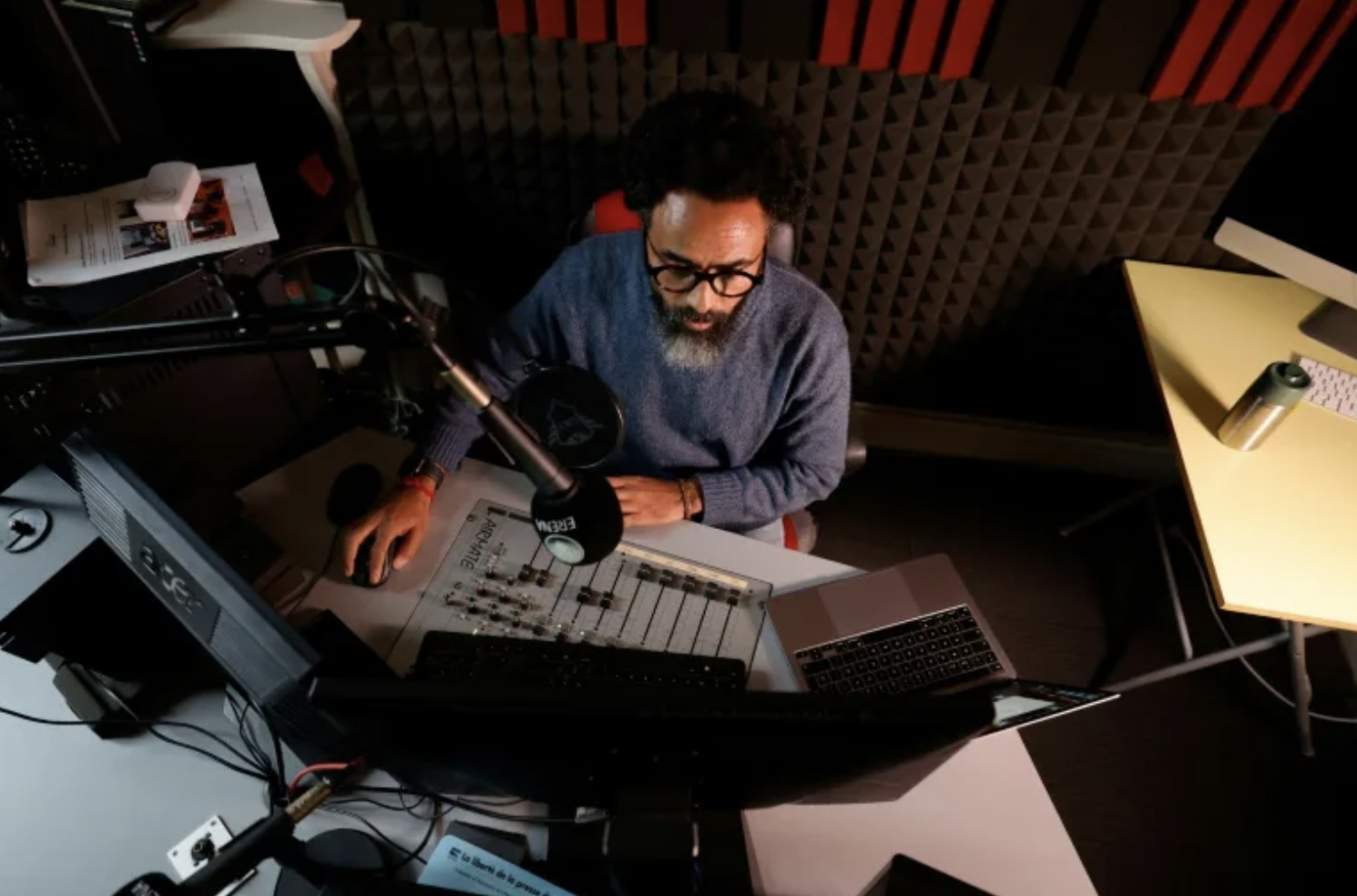
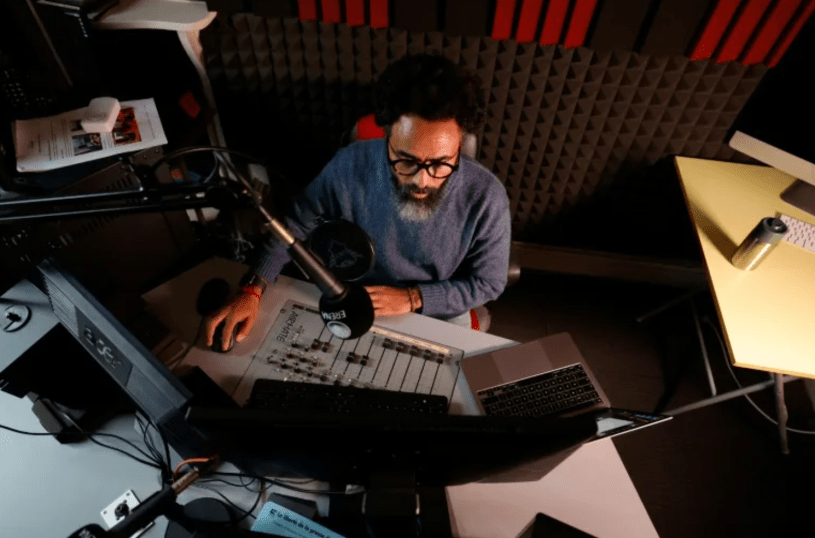
Amanuel Ghimaï Bhata, journalist and editor-in-chief of Radio Erena, ‘Radio our Eritrea’, in Paris on 31 October 2024 (Gregoire CAMPIONE)
From a tiny studio tucked away in a flat in Paris, the airwaves of Radio Erena take flight. The only independent medium accessible in the information black hole that is Eritrea, it could nevertheless disappear for lack of funding after 15 years of existence.
Every day, Radio Erena, which means ‘Radio our Eritrea’ in Tigrina, reports in Tigrina and Arabic on life as it is in this country described as Africa’s ‘North Korea’.
Politics, freedom of expression and security are all covered by a network of correspondents based outside the country, free from the censorship of a state ruled with an iron fist by Issaias Afeworki since his declaration of independence from Ethiopia in 1993, after three decades of war.
‘In 2001, the Eritrean government decided to close down all private media. Since then, only the voice of the state has been heard, mainly propaganda,’ points out Amanuel Ghimaï Bhata, journalist and editor-in-chief of Radio Erena.
A handful of media are trying to resist by broadcasting from abroad, the vast majority of them linked to Eritrean political movements. Radio Erena is the only one of them to be ‘independent and apolitical’, according to its management.
Although it is difficult to estimate the number of listeners, given the limited access to the country, the German foundation Deutsche Welle Akademie estimated in 2017 that ‘520,000 people in Eritrea listen to radio (Erena) at least once a week’.
– ‘Not a word’ –
Eritreans want to know ‘what’s happening on the other side of the world’, as well as ‘outside their borders’, particularly in northern Ethiopia where their army has fought alongside Ethiopian federal forces against rebel groups in Tigray, explains Amanuel Ghimaï Bhata.
But while Eritrean soldiers are still in the region, where hundreds of thousands of people have died and a million others have been displaced in two years of conflict (2020-2022), ‘the Eritrean government is not saying a word about it’, he sighs.
The state media give ‘a completely illusory image of Eritrea, giving the impression that everything is still going well’, observes Marc Lavergne, director of research at the French Centre national de la recherche scientifique (CNRS) and a specialist in the Horn of Africa. ‘Press freedom is non-existent in Eritrea. Only North Korea is at the same level’.
The NGO Reporters Without Borders (RSF) estimates that Asmara even manages to do worse than Pyongyang, ranked 177th out of 180 countries in its world press freedom index. Last place goes to Eritrea, described by RSF as ‘the number one prison for journalists in sub-Saharan Africa’.
In this ‘extremely tightly controlled totalitarian system’, ‘only a handful of loyalists to Issaias Afeworki’s regime have access to the outside world, the Internet and the international press’, comments Marc Lavergne.
– A bubble of freedom –
Radio Erena is a bubble of freedom in a totally controlled media landscape. But not without its difficulties.
In 2012, accused of ‘inciting its listeners to acts of violence against representatives of the Eritrean government’, it was suspended, as RSF documented at the time. ‘We were unable to broadcast for nearly eight months’, recalls Amanuel Ghimaï Bhata.
The journalist in exile, who left Eritrea in 2009 after working for several years at the Ministry of Information, where he says he was forced to submit to the ‘propaganda machine’, reports ‘numerous threats’ more recently.
Maxence Peniguet, director of operations at the association that oversees Radio Erena, founded in 2009 with the support of RSF, lists cyber attacks perpetrated by ‘tens of thousands of robots that visit the site to overheat the hosting’.
But the fear is mainly financial. The funds currently allocated by private sponsors, American and European NGOs, are no longer sufficient to cover the costs of the radio station. And convincing institutional backers is ‘very complicated’ given the context of widespread ‘crises’, he points out.
In the space of a year, the Radio Erena team has shrunk from six to three people, including two experienced journalists who fled to France from Eritrea.
Without new financial partners, ‘we will have lost almost half our budget for 2025’, laments Mr Peniguet, who fears that Radio Erena’s voice ‘will die out in a few months’.
ecb-jf/dab/mba

