In a statement, the Tigray People’s Liberation Front (TPLF) accused the Ethiopian government of violating the Pretoria Agreement by carrying out drone strikes on the night of 10 November.
A Tigray army commander, who did not want to be named, told BBC Tigrinya — through our reporter Ghirmai Ghebru — that the attack took place on a Tigray army base in the Milka area.
Brigadier General Gebregziabher Beyene (“Wedi Antru”), the commander of the Free Land group, told BBC Tigrinya that he had no additional information beyond what had been posted on social media.
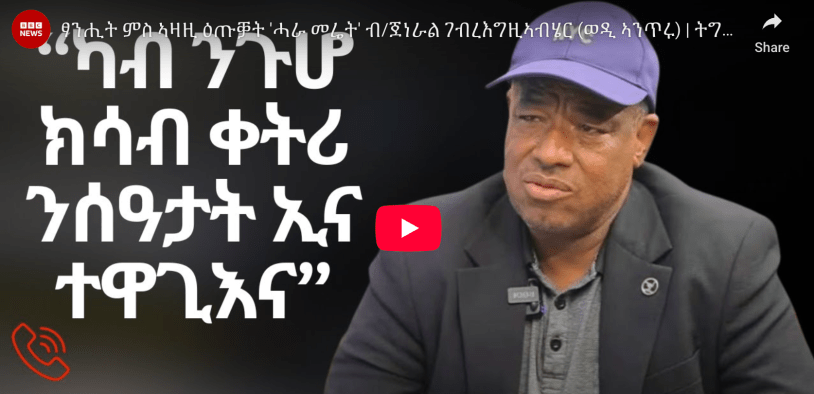
Here is the YouTube interview conducted by BBC Tigrinya with Brigadier General Gebregziabher Beyene.
[General Wedi Antiru (Gebregziabher Beyene) has been seen with Tigray Peace Force (TPF) members.]
You know, in the past we used to operate in Afar. But when they [TDF] entered Afar, we shifted to the border areas of Tigray. We’re no longer in Afar; we’ve moved into our own areas of Tigray. But they [TDF], because they seem to have an obsession with Afar, think we’re still there. We’re not in Afar—we were there recently, but not anymore.
You’re saying you’ve entered other areas of Tigray as well. So first, which areas have you entered? And second, there are accusations that when your forces entered those areas of Tigray, human casualties occurred. What’s your response to that?
We, from the beginning, didn’t have any plan to fight with Tigrayans. We got out [of Tigray] because they wouldn’t let us remain in Tigray; we couldn’t get anyone to listen to us. Speaking [out] became a sin, and speaking [out] resulted in imprisonment, persecution, and slander. So we were distressed [had no option]; that’s why we left—not because there was an enemy force in Tigray we wanted to fight against. There isn’t a force we will fight against, nor have we categorized anyone as an enemy. The one we call an enemy [inaudible]. We shifted into Tigray because they came to Afar. Since we shouldn’t fight [them] even in Afar, we shifted and entered into Tigray.
General, can you tell me which areas you have entered and when you entered them?
This is a military secret. There are certain military matters that shouldn’t be disclosed. First of all, we’re smaller in number, and they’re hunting us—we’re being hunted. So I can’t say, “We’re in this place, come find us.”
I asked this question because it might be new to our listeners.
Yes, what I told you—you must have heard there was a clash recently. Yesterday, they released a statement about it. There was a clash [fighting] when Tadese came to Raya. I think you want to know why the clash happened. Our [forces] were on the Afar border. Neither I nor others were aware of Tadese’s arrival—we were focused on our work; we don’t spend our days watching Tadese. Early in the morning, since the border areas of Afar are strategic locations, they suspected [our presence] and opened fire when they came there. The place where they opened fire was Afar territory, on the border. I didn’t know Tadese was going to come. In the end, they [TPF] defended, and the forces that came [TDF] tried to attack.
Eventually, they were pushed back, and our forces pursued them and carried out a counterattack. They advanced into some areas—this reached Gereb Agew. Finally, we told them to return to their positions since the fighting must not spread beyond that. We turned them back. When we turned them back, they followed us and entered Afar, into an area called Tomsa and [inaudible]. They entered Tomsa and displaced Afar residents—they have displaced [people from] many kebeles.
When we found out they were coming, since we must not fight against our brothers—and since they must not enter Afar and cause bloodshed—we withdrew to a place where they couldn’t find us; we withdrew to an area in Tigray. It’s not a beneficial [strategic] location; [we went there only] because we had to withdraw from the fighting.
General, to make it clear—did the fighting on Wednesday between the Hara Meret militants and the Tigray Forces start when you tried to enter Tigray’s territory, or did the Tigray Forces enter Afar territory where you were stationed and attack you? What exactly happened?
Tomsa is located 18 kilometers from the Tigray border. They entered later. We were initially on the border beyond Tomsa. We were at the place where Sherifo’s soldiers were showing the burned metal sheets—that’s where we were, near the Raya border. They [TDF] were [also] near the Raya border, to make it secure. It was Raya territory; it was a strategic spot. Our [forces] were there, and that’s where the clash happened. They [TDF] entered Tomsa after that.
So, does that mean you retreated? And how long did the fighting last?
First, they came around 5:30 a.m. Then the fighting started. It continued until 11 a.m. or 12 p.m. They followed [us] back. They knew we were in Tomsa, so they entered Tomsa and conducted a search. You’ve seen the soldiers who were conducting the search. Sherifo got there and was saying, “This is Afar [territory] and so on,” as you have seen. [But] they released a statement denying that they entered Tomsa.
Sherifo is the commander of Army 33, [correct]?
Yes. Fisha released a statement denying that they entered Tomsa. But Sherifo had entered Tomsa and was speaking [there]. Fisha’s forces entered [Tomsa] and were saying, “We have entered Tomsa.” So they themselves were admitting they entered Tomsa. It’s better to look at what they said there.
You are telling me you fought around 7 or 8 hours…
We conducted a counterattack and advanced as far as Gereb Agew [Tigray]. We entered Gereb Agew. After that, I learned that Tadese was visiting [the area]. They [TDF] also gathered forces and started to come [to fight us]. We withdrew, believing that [inaudible]. When they learned we had withdrawn, they followed us. When we realized they were pursuing us, we said, “It could [expand] into heavy fighting,” so we left to avoid further conflict.
General, you fought for seven or eight hours. What were the human casualties on your side?
We [seek] to establish order in Tigray; we want to stop the [intra‑Tigrayan] bloodshed. We believe it is wrong for Tigrayans to fight each other. Therefore we don’t want any footprint of that on us. Our preparation isn’t for our forces to engage in bloodshed.
Whether the loss is on this side or that side, it is the loss of Tigrayans; it is a collective loss. I believe the loss of the other side is also my loss — it is the loss of Tigrayans. They are Tigrayans I know; they are kids I know. They were with me. [Army] 33 was a unit that was with me. So those who are martyred there are Wedi Antru’s army’s loss; it is Tigrayans’ loss. Our martyrdom too is Tigrayans’ loss.
I know they [TDF] lost lives. We don’t involve many units in the fighting. But they say, “Get them,” and [deploy many troops] from the back and front. We make [our forces] fight very cautiously. Let me tell you openly: we haven’t suffered any losses — one person was shot in the foot. You can confirm that through other means. We don’t have any other losses. I know they suffered losses. I don’t want to say, “We killed this many and wounded this many.” I believe that too is my loss and my problem.
Since I believe it is the loss of Tigrayan youth who took part in the resistance, I am not willing to present it as a victory. It is tragic. Let the Tigray people see it; they know it. It would not be right for me to detail the martyrdom of Tigrayans.
The Afar regional administration released a statement claiming that Tigray forces attacked civilians. But you’ve told me you fought for seven to eight hours. Was the area where you were stationed inhabited by civilians?
The area we were in initially—the border area where they came [and attacked]—we were at the last border. There were no Afar residents there. We were in the desert. Since there was training, they [TPF combatants] had rested there. The fighting took place in Wejerat. It didn’t affect the Afar. [The civilian casualties] didn’t occur while we were participating in the fighting.
The statement released by the Afar [administration] refers to what happened later, when Medid’s forces got organized [regrouped] and, by bombarding [the area] with mortars, rockets, and Zu, displaced [residents of] many kebeles.
Which kebeles, General Wedi Antru?
Those belonging to Afar, located in Tomsa. Tomsa is a small town. The seven or eight kebeles around Tomsa—they bombarded [them] with mortars and entered there. They are still there.
Why did you choose to conduct your operations in Afar territory? Why don’t you remain in Tigray’s territory? There are accusations that your presence there has sparked conflict with neighbors. I’d like you to respond to that.
I’m telling you, the conflict occurred while we were in Tigray. We were unable to remain there. Those who came to [join] us did so out of anger; they said, “Was this the Tigray we fought for?” But we love Tigray deeply. We are also present in Afar; we are present in Raya; we are present in Shire; we are present in Mekelle; we are present in Tembien; we are present in Adwa—we are everywhere. Last time, I told you, “We are in Afar.” Now, we are everywhere in Tigray.
You’re saying you responded [to a provocation] and carried out a heavy attack. Where did you get the weapons that enabled you to do this?
There are a lot of weapons in Tigray. We were part of the resistance. The forces that came [to us] weren’t trained now; they were part of the resistance and had received their training there. It was a force we had trained there [Tigray] and deployed in fighting. They brought [their guns] here. They brought with them the weapons they had been armed with in various camps. We know where the weapons are [stored]. I know it; others know it; the units there know it—they gave them to us. So we are fully armed.
The federal government knows that you are [operating] in Afar. What is your agreement [with the federal government], and how long will it continue?
Firstly, no one funds us. It is concerned Tigrayans and our supporters who fund us. Secondly, we have no agreement [with the fed]. We left our budget and exited [to Afar]. The [federal] government is giving our budget to Tigray. It is giving it to those who are snatching stamps. We accuse the government of cooperating with those who are snatching stamps.
If the government isn’t funding you, where do you get the money to pay the combatants’ salaries? Where do you get your logistics from?
We are not paying them salaries. We are giving them pocket money for soup and so on. Secondly, we have supporters, and there is the Tigray people. Many Tigrayans support the change. There are also many investors who support the change. We accuse the federal [government] of aggravating Tigray’s suffering by supporting those who are inflicting suffering on Tigray.
What do you think should be done to prevent a relapse into bloodshed? What preconditions do you propose for the two sides to lay down their arms and enter into peaceful negotiations?
First, a national council or government that has the trust of all Tigrayans must be established. Right now there is no government; it is being governed by warlords. We need a government.
Second, the Tigray people had their own army, called the TDF. It was the best army. The TPLF have turned this best army into their servants. This must be reversed. [the army] should undergo reform and be brought under the government.
Third, in the name of “above corps,” grave crimes have been committed against the Tigray people for not supporting the TPLF. Individuals were killed or maimed, properties were destroyed, people were exiled, and lives were wrecked. This was done because of the “above corps.” There must be accountability for the losses incurred; [perpetrators] must be brought to justice.
The chaos, theft, robbery of mines, and illegal activities must be stopped. All the conflict in Tigray should be properly addressed, and attention should be redirected to development.
Our displaced people are dying and being eaten by hyenas. Our forces in Sudan are [taking part] in fighting; they are in a difficult situation. The people shouldn’t be toyed with by the cadres. They must be returned. There must not be a [precondition] such as “TPLF must be present.” Whoever is [in charge], they must be returned to Humera and their security must be safeguarded.
Our territories must be restored. Sovereign territories will not be restored through force. We have the Pretoria agreement. We should calm down, rectify our diplomacy, rectify our character, and rehabilitate Tigray.
General Gebregziabher Beyene, I would like to thank you for granting us this interview.
BBC News, 10/11/2025

