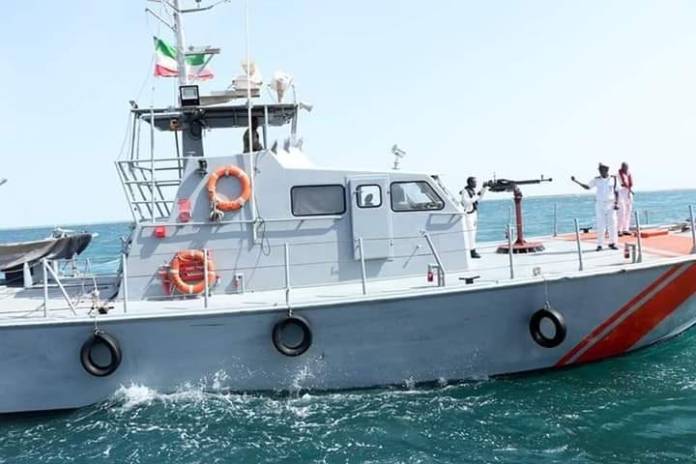
The Somaliland Coast Guard’s escort services represent a model of regional self-reliance that deserves the support of all stakeholders—including international insurers, shipping lines, and foreign governments.
Source: Sahan Somalia Wire Issue 948 | April 15, 2026
| As global energy markets reel from the partial shutdown of the Strait of Hormuz and war insurance premiums skyrocket by nearly 4,000%, an unlikely maritime security provider is emerging as a critical stabiliser in one of the world’s most vital shipping corridors. The Somaliland Coast Guard, operating from the port city of Berbera, has quietly begun providing maritime escort services, seeking to reduce shipping insurance costs—and consequently, the price of commodities and energy for consumers across the Horn of Africa and beyond. With Iran’s ongoing conflict disrupting tanker traffic through the Strait of Hormuz—through which approximately 20% of global oil consumption transits—the ripple effects have reached every corner of the global economy. Yet Somaliland’s proactive maritime security posture is demonstrating that regional actors can play a decisive role in mitigating these shocks. To understand the significance of the Coast Guard’s escort services, one must first understand the mechanics of maritime war risk insurance. This specialised coverage protects ships and cargo against losses from war, terrorism, piracy, and other geopolitical threats. Maritime insurance operates on a classification system maintained by the Joint War Committee (JWC), a body of underwriters from the Lloyd’s Market Association and the International Underwriting Association. The JWC designates ‘Listed Areas’—high-risk zones where insurers require advance notification and additional premiums for vessels to enter. These designations directly determine the cost of shipping. On March 3, 2026, the JWC issued its latest update, JWLA-033, which dramatically expanded the war risk “excluded areas” to include Bahrain, Djibouti, Kuwait, Oman, and Qatar. Significantly, it redefined the boundaries of the Persian Gulf, the Gulf of Oman, the Indian Ocean, the Gulf of Aden, and the Southern Red Sea to encompass a vast maritime zone. There are three primary types of maritime insurance that affect commodity prices. The first is Hull and Machinery Insurance, which covers the physical vessel itself, and standard policies typically exclude war risks, requiring separate coverage. The second is War Risk Insurance, through which specialised coverage is activated when vessels enter designated ‘Listed Areas.’ Premiums are calculated as a percentage of the vessel’s value, with rates fluctuating based on threat levels. The third is Protection and Indemnity (P&I) Insurance, which covers third-party liabilities, including environmental damage, cargo loss, and crew injuries. P&I clubs issue “war risk withdrawal notices” when vessels enter high-risk zones, requiring owners to secure additional coverage. The cost implications have been staggering. Before the current Iran conflict, war risk premiums for the Persian Gulf stood at approximately 0.1 to 0.25% of a vessel’s value. By March 6, 2026, rates had surged to approximately 3%, and some markets placed them between 4 and 10% for higher-risk profiles. For a Very Large Crude Carrier (VLCC) valued at USD 100 million, a 2% war risk premium translates to USD 2 million per passage—approximately USD 1 per barrel of oil. With rates ranging from 3 to 5%, insurance costs alone can exceed USD 1.50 to 2.50 per barrel. In extreme cases, premiums have approached 10%, pushing purely insurance costs beyond USD 5 per barrel. These costs are passed directly to consumers. When shipping lines face an additional USD 2–3 million in insurance costs per voyage, those expenses appear in the price of fuel at the pump and the cost of imported goods on store shelves. Somaliland’s coastline stretches along the Gulf of Aden, one of the world’s most critical maritime chokepoints. The Gulf connects the Red Sea to the Indian Ocean via the Bab el Mandeb Strait, through which approximately 10% of global trade and up to 12% of global oil transported by sea passes annually. The Port of Berbera, located just 250 kilometres east of the Bab el Mandeb, is strategically positioned to serve as a buffer against regional disruptions.Somaliland’s Coast Guard is uniquely positioned to address future maritime crises. Consider the impact of a full shutdown of the Bab el Mandeb—a scenario that remains plausible given the ongoing conflict in Yemen and tensions in the Red Sea. If that chokepoint were closed, shipping would be forced to divert around the Cape of Good Hope, adding thousands of miles to voyages and upending global supply chains. In such a scenario, Somaliland’s ports and maritime security infrastructure would become even more critical. The Coast Guard could serve as the first responder for vessels seeking safe harbour, the coordinator of emergency shipping lanes, and the security guarantor enabling continued trade. The Somaliland Coast Guard’s escort services directly address the two factors that insurers use to calculate premiums: risk assessment and risk mitigation. When a vessel transits through a JWC-designated ‘Listed Area’ without security arrangements, insurers assume the worst-case risk profile. However, when a national coast guard provides active escort—demonstrating a commitment to maritime domain awareness, surveillance, and rapid response—the risk profile changes. Insurers can factor this security presence into their underwriting models. The mechanism works as follows. First, through the transfer of risk, when the Coast Guard escorts vessels through Somaliland’s territorial waters and adjacent shipping lanes, it effectively transfers risk from the vessel owner to a state security provider. Second, insurance rates are heavily influenced by loss history. Somaliland’s territorial waters have recorded no successful pirate attacks in over a decade—a fact that insurers must acknowledge despite outdated regional classifications. The Coast Guard’s 24-hour emergency hotline and rapid response capabilities provide insurers with verifiable security protocols that justify reduced premiums. For ships bound to Berbera Port—which handles a growing share of Ethiopia’s maritime trade and serves as a critical alternative to congested Djibouti—the Coast Guard’s escort services mean lower total shipping costs. These savings translate directly to reduced prices for commodities, fuel, and consumer goods imported through Somaliland. Despite Somaliland’s strong maritime security record, its territorial waters remain lumped into a high-risk insurance classification—a direct consequence of the Republic’s lack of international recognition. The JWC’s ‘Listed Areas’ designation currently extends from the Somalia border at 1°40’S, 41°34’E outward into the Indian Ocean, encompassing waters that Somaliland has successfully secured for years. No piracy incidents have occurred in Somaliland’s territorial waters, yet the Republic’s lack of diplomatic recognition means it cannot negotiate independently with international insurers or advocate for reclassification. This bureaucratic reality imposes a hidden tax on every ship that calls at Berbera and every consumer who depends on the goods that flow through it.Admiral Ahmed Hurre Haariye, Commander of the Somaliland Coast Guard, has affirmed his service’s readiness to assume a larger role in maritime security. In a recent statement, he emphasised that the Coast Guard holds exclusive legal authority over Somaliland’s maritime security—a mandate that extends to escort operations. The Admiral noted that the Coast Guard has been consistently combating piracy and transnational maritime crime for decades, developing professional personnel capable of delivering the security outcomes insurers and shipping lines require. With approximately 1,000 active personnel and a fleet that includes Defender-class vessels, the Coast Guard has steadily built the operational capacity to conduct escort missions. Recent international training programs have further enhanced these capabilities. In March 2026, Coast Guard officers completed an advanced training program supported by IORIS (Indian Ocean Region Information Sharing), an international maritime coordination platform that promotes cooperation among Indian Ocean security agencies. The training focused on maritime surveillance, information sharing, operational coordination, and responding to maritime threats, including illegal fishing, smuggling, and piracy. To tackle the rising global prices of commodities and energy, the Somaliland coast guard commander stated that the Berbera Secure Approach Protocol (BSAP), which will provide maritime escort to ships sailing to Berbera Port, will soon be introduced to lower the high insurance premiums paid by ships. This will, in turn, have a positive impact on the prices of goods and energy in the local market, as well as on goods bound for Ethiopia. This will also improve the performance of the Berbera Port, which is expected to serve more ships. The distance between the maritime border with Djibouti and Berbera Port will be designated as a Secure Maritime Zone, where the Somaliland Coast Guard will provide a maritime escort to ships that follow the Secure Approach Protocol and are sailing to or from Berbera Port. Once the BSAP is communicated to insurers and shipping lines, a BSAP Compliance Certificate will be issued to the ship for use in negotiating reduced insurance premiums with war risk and P&I insurers. The BSAP is designed to complement, not replace, existing international security frameworks, including BMP5, ISPS Code, and IMO guidelines. Vessels should continue to follow all mandatory international requirements. The Somaliland Coast Guard’s escort services represent a model of regional self-reliance that deserves the support of all stakeholders—including international insurers, shipping lines, and foreign governments. For international insurers, recognising Somaliland’s security record and engaging with Coast Guard leadership to establish verified security protocols would enable more accurate risk pricing. The current classification that lumps Somaliland into a generic high-risk zone is both inaccurate and economically damaging. For shipping lines, utilising the Coast Guard’s escort services and communicating their effectiveness to insurers would help build the loss history needed to justify reduced premiums. For foreign governments and international organisations, supporting the Coast Guard’s capacity-building efforts—through training, equipment, and diplomatic recognition—represents an investment in global maritime security. And for regional consumers, understanding that maritime security directly affects the price of goods creates political support for the investments and policies that sustain Coast Guard operations. The partial shutdown of the Strait of Hormuz has reminded the world of a fundamental economic truth: maritime security is price stability. When shipping insurance costs spike by a factor of 40, so do the costs of food, fuel, and medicine. Somaliland’s Coast Guard is demonstrating that regional actors can play a decisive role in stabilising these costs. By providing escorts to ships bound for Berbera and vessels transiting the Gulf of Aden, the Coast Guard reduces risk, lowers insurance premiums, and ultimately reduces the price of commodities for consumers. The classification of Somaliland’s territorial waters as a high-risk area may artificially inflate these costs. But Somaliland’s Coast Guard offers an alternative, and stands ready to serve as the maritime security provider that one of the world’s busiest shipping lanes so urgently needs. By the Somali Wire Team |

