For me, the biggest obstacle facing us isn’t the old colonial lines on the map anymore. It’s the invisible walls we’ve built in our own minds, the habit of seeing our neighbors first as rivals or threats instead of partners in a common destiny.
By Siraj Ahmed
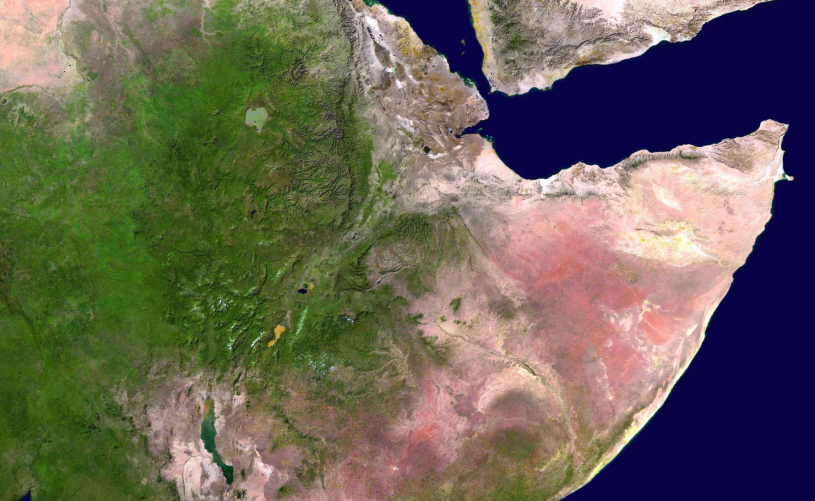
When I look at a map of the Horn of Africa, I don’t just see lines dividing countries like Ethiopia, Somalia, Eritrea, Djibouti, and parts of Kenya and Sudan into separate entities. Instead, I see one interconnected region whose people have been linked for centuries through trade, migration, cultural exchange, and, at times, conflict and conquest long before colonial powers arrived with their rulers and treaties. Merchants moved goods and unfortunately, hundreds of thousands of slaves from the Ethiopian highlands and interior down to the ancient ports of Zeila, Berbera, Massawa, Suakin, and onward across the Red Sea to Arabia, India, and beyond. Somali pastoralists followed the seasons across vast landscapes in search of water and grazing land. Islamic scholars journeyed between centers of learning in Harar, Zeila, Mogadishu, Cairo, and Mecca, exchanging ideas that enriched us all. The Red Sea, the Nile, and the Indian Ocean served as highways for commerce, ideas, and people, even as empires rose and fell.
This history isn’t a simple romantic story from the past. It includes prosperous exchanges that built vibrant societies and sustained trade networks for over a thousand years. It also includes darker realities: the long-standing Indian Ocean and Red Sea slave trade, in which African captives were exported for centuries before European involvement, as well as military campaigns and shifting control over territories. The Kingdom of Aksum, for example, projected power across the Red Sea, intervening in southern Arabia (Himyar) in the 6th century. Ethiopian rulers clashed with Egyptian and Sudanese neighbors, while coastal areas saw influences and conquests involving Egyptians, Greeks, Romans, Ottomans, and others. Borders and spheres of influence were enforced where power allowed, even if they were often more fluid than today’s nation-state lines.
What this complex past shows is that connections across what we now call borders are deeply rooted in the region’s story — not a foreign or purely modern invention. Trade, migration, and interaction were enduring features, even amid competition and violence. Colonialism in the late 19th century, formalized at the Berlin Conference, dramatically redrew and rigidified these maps with little regard for existing communities, clans, and economic ties. Families and groups that had interacted for generations were suddenly split across colonial administrations. When independence came more than sixty years ago, most African leaders, wary of chaos and conflict, kept those same colonial borders intact. It helped avoid some immediate wars, but it also locked in divisions that were ill-suited to building strong, integrated societies in a region with such deep historical interconnections.
I’ve seen how these borders continue to raise transportation costs, choke legitimate trade, separate families who just want to visit relatives, complicate investments, and hold back real economic progress in a region where intra-African commerce often stays painfully low, sometimes under 15 percent of total trade, compared to much higher figures in Europe or Asia. What frustrates me most is how the biggest problems we face today pay no attention to those lines at all. Drought doesn’t stop at any checkpoint. Floods don’t ask for visas. Human trafficking networks thrive in the gaps between our governments. Diseases spread without permission. Climate change, with its desertification and erratic rains threatening to displace millions, doesn’t care about nationality or sovereignty. These are regional crises that demand regional answers, yet we still make it simpler for many of us to travel or study thousands of miles away in Europe or elsewhere than to move freely to a neighboring country right next door. That irony should trouble every one of us who cares about our shared future. Europe isn’t perfect, and I don’t hold it up as some flawless model, but look at what they achieved after destroying themselves in two world wars that killed tens of millions. Instead of staying trapped in endless division, they slowly built institutions for trade, investment, education, and easier movement, like the Schengen Area, learning the hard way that cooperation could bring prosperity without erasing their individual identities. If nations that fought some of history’s bloodiest conflicts could choose integration while keeping their sovereignty, why do we in Africa so often view deeper regional ties with suspicion or fear?
The Horn sits on one of the planet’s most strategic maritime routes, with hundreds of millions of people, massive livestock resources that could feed markets far and wide, fertile lands, huge potential for renewable energy like geothermal and wind, growing ports such as Djibouti and Berbera, and a young, energetic population ready to link Africa with the Middle East, Asia, and Europe. We have everything we need to thrive, yet we remain one of the least integrated regions economically, held back by political mistrust, recurring conflicts, weak roads and rails, corruption that drains public funds, poor governance, ethnic and clan divisions that dominate politics, and leaders too often thinking only in short-term power plays instead of long-term vision. I’ve come to accept a hard truth that many prefer not to say out loud: while colonialism left real wounds, we can’t keep blaming outsiders for everything. No foreign government forces our officials to steal public money, weaken institutions, or turn politics into a contest of identities rather than building real development. Those are choices we make today, and they keep us exporting cheap raw materials only to import expensive finished goods, watching our best-educated youth leave for better chances abroad, and wasting resources on barriers that smarter cooperation could tear down. This path isn’t sustainable, and deep down, I believe most of us know it.
True regional cooperation doesn’t mean erasing borders or giving up our sovereignty. It means making those borders less of a daily obstacle to honest trade, family visits, education, tourism, and joint investments. It means building shared railways, highways, power lines, water systems, ports, and digital networks instead of duplicating weak ones in isolation. It means pooling intelligence to fight terrorism and trafficking together, and realizing that when our neighbors grow stronger and more stable, it directly lifts our own security and prosperity, just as our ancestors understood in those old trading networks.
History has taught me that the most enduring civilizations were rarely the isolated ones. They were the connectors, the ones who linked people, markets, ideas, and knowledge across distances. The Horn did this brilliantly before, and there’s no reason we can’t revive that spirit now. I want the next generation to grow up in a region where opportunities cross borders faster than poverty or conflict does, where trade and learning move quicker than weapons or lies, and where working together becomes more powerful than old divisions. Speeches and summits alone won’t get us there. It will take honest leaders who can be held accountable, strong institutions that actually serve the people, real investment in education that keeps talent at home, respect for the rule of law, economic reforms that reward hard work and innovation, and ordinary citizens like you and me willing to look beyond narrow clan, tribal, or partisan interests toward something bigger.
For me, the biggest obstacle facing us isn’t the old colonial lines on the map anymore. It’s the invisible walls we’ve built in our own minds, the habit of seeing our neighbors first as rivals or threats instead of partners in a common destiny. The day we tear down that mindset and embrace real cooperation, shared responsibility, and a vision that stretches across generations, that’s when the Horn of Africa will finally start living up to the incredible potential it has held for centuries. History already gave us this shared land and these deep connections. The future is ours to shape, if only we choose to build it together.
Siraj Ahmed
Ahmedsiraj1198@gmail.com
Minnesota

