Source: Daily Friend
- Jonathan Katzenellenbogen
- Jul 29, 2026
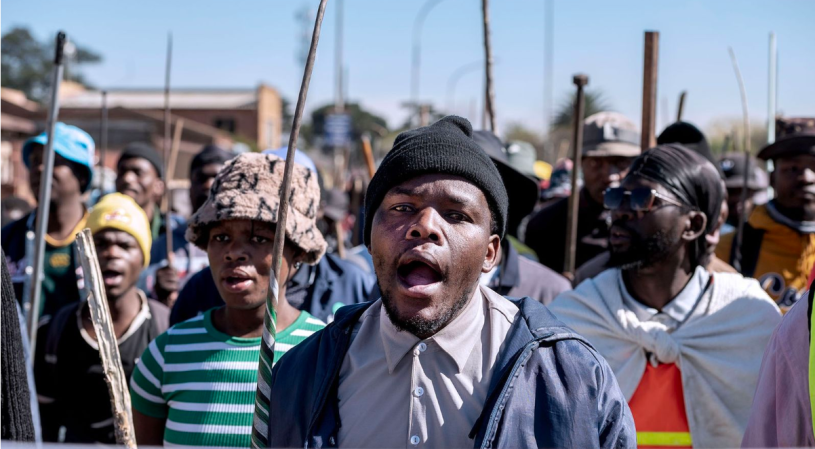
We have moved onto new and far more uncertain terrain since June 30th. That’s the date the anti-illegal immigration vigilante group, March and March, imposed as a deadline for foreigners who are here illegally to depart.
The ongoing violence and intimidation against foreigners by vigilante groups has wrecked SA’s relations with many African countries. And the events of the past few weeks have also sparked severe doubts that we are a country based on solid rights and the rule of law.
And with that, the events of the past month have also raised concerns about our political stability.
SA periodically goes through periods of extreme violence against foreigners, but this one could last far longer. In 2008, the violence against foreigners lasted two to three weeks, but this could last longer.
The anti-immigration cause is a popular one, but it takes good organisation and money to mobilise and launch a campaign. The timing of the launch of the latest campaign shows an attempt to push the ANC off balance ahead of the local government elections on November 4th.
As Antony Sguazzin of Bloomberg points out in “South Africa’s vision as Continental Leader is Vanishing Fast,” which ran earlier this week, the ANC has prevented an escalation in the violence. But, “they’ve been less strident in condemning the violence.”
“Ahead of elections in November, government officials have been expressing understanding of the frustrations behind the protests, and talked up their efforts to speed the deportation of undocumented migrants and tighter border security,” he writes.
That is precisely why there has been a lack of leadership in dealing with the latest iteration of anti-immigrant violence.
The marches are continuing in some industrial areas in metropolitan areas and smallish towns around Gauteng and in other provinces. Roving mobs attacking people they think are foreigners have raised anxiety among those who are outsiders or part of a minority group. This is a new and toxic environment for the country.
The country would bear a heavy price if the anti-immigration protests gain a momentum of their own and carry on well beyond the elections.
On the eve of the June 30th marches against migrants, a group representing Tsonga people protested against the vigilantes, who they say unfairly target their community based on tribal affiliation. Other groups could soon assert themselves and bring ethnic differences to the fore.
And there is always the risk that mass bodies organised for one purpose could morph into far larger and more dangerous movements.
Illegal immigration is a big problem, but the more fundamental problem is the inability of law enforcement to do a proper job. That is precisely why there is a massive influx of illegal migrants and much of the reason for the rise of vigilante groups and the use of violence against immigrants.
So far, the largest impact of the demonstrations has been on the lives of the departed migrants and the economic hit SA is taking. Many businesses dependent on foreign labour have had to close, and shops reliant on customers who come from outside the country have taken a heavy hit. That will grow in coming months.
And SA’s position in Africa and globally has been pretty much trashed.
Over the past few weeks, we have seen SA ripped from its Africa leadership position. With our much-reduced role in peacekeeping across the continent and President Donald Trump kicking us out of the G20, our Africa role is much diminished. Seeing SA host the G20 gave us a stature among fellow African countries.
We were invited into the G20, elected to a temporary seat on the UN Security Council, and invited to Group of Seven meetings because of the Mandela legacy and support from countries on the continent.
That support has now gone. African countries are well aware of our weakened military and diplomatic posture as an intermediary with the world powers. Since the fleeing of their citizens, key African players such as Ethiopia, Ghana, and Nigeria have displayed anger towards SA.
Countries in our region, including Mozambique, Malawi, and Zimbabwe, have delivered strong protests to the SA government about the poor treatment of their citizens in the country. They are now in no mood to do us any favours.
To try and at least hear them out and prevent a further deterioration, SA’s International Relations and Co-operation Minister, Ronald Lamola, has been doing the rounds, but there are no signs that this has done much good.
How does he explain the absence of tough law enforcement to prevent mob rule by vigilantes to foreign governments forced to repatriate their citizens?
And how do you explain the many stories of arbitrary arrest of foreigners who are legally in the country?
But the most pressing question is how do you explain to fellow African governments the lack of leadership by the ANC?
The African Union (AU) will formally discuss the attacks at its next summit in October. Ghana has delayed a planned summit between its President, John Mahama, and President Cyril Ramaphosa that was to have taken place early next month. The Ghanaians explicitly cited the surge in anti-migrant violence and the emergency repatriation of 900 of its citizens as the reason for the cancellation.
Last week, two Ghanaians filed a petition at the International Criminal Court (ICC) in The Hague for an investigation into attacks on foreigners in SA. The petition alleges that there is a “pattern of widespread and systematic attacks” against migrants in SA and accuses President Cyril Ramaphosa’s government of failing to prevent or punish those crimes, including murder. They have asked the ICC to open a preliminary investigation into migrant attacks, which they say could constitute crimes against humanity.
Lamola has dismissed the petition, saying it failed to meet ICC requirements. He also said that SA has an independent judiciary, active law enforcement, laws such as those on hate crime and equality, and is fully equipped to deal with unlawful conduct.
But we have yet to see a spate of prosecutions for the killing of foreigners and the burning and looting of shops or shrill and continuous strong warnings from the ANC about the use of violence.
As much as Lamola may protest about the court action by Ghanaians, this wipes out SA’s claim to any moral high ground in its effort to have Israel found guilty of genocide over the war in Gaza.
But the world is watching. Human Rights Watch has already come out with a report on the “Waves” in SA.
The world has noticed a failure in the rule of law and a lack of leadership.

