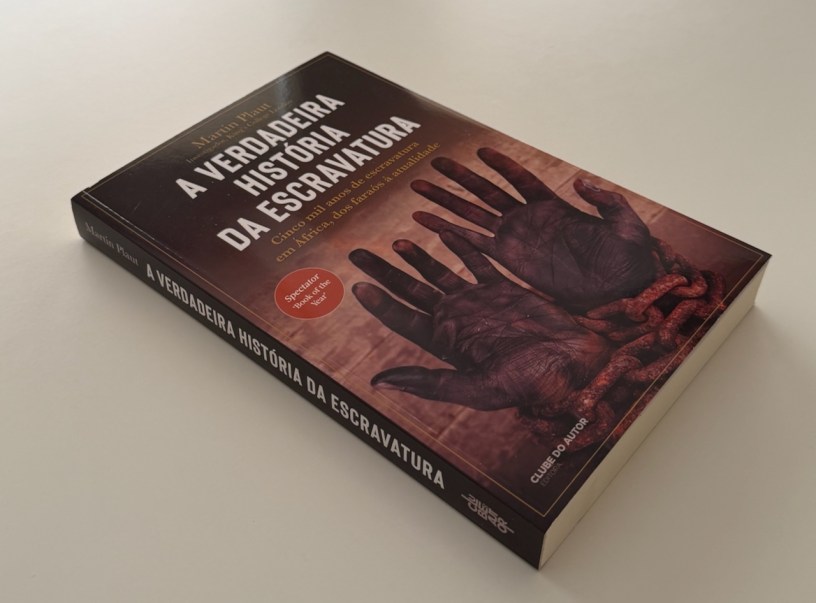
My book: “Unbroken Chains: a 5,000 year history of African Enslavement” will be published in Portuguese on 24th September.
I am delighted, as the Portuguese were the first to traffic Africans across the Atlantic and expanded enslavement deep into Africa. They also made strong ties with local African elites to ensure that slavery succeeded.
The English version is due to appear in an updated form in paperback in 2027.

Here are some brief extracts from English book, which I hope are informative.
Introduction
‘In I44I Antao Goncalves, the young captain of a small vessel dispatched by the infante Dom Henrique of Portugal to take on a cargo of seal skins and oil, put ashore a landing party on the coast of northern Mauretania for the express purpose of capturing blacks.’[1]
So began the trade that would continue for the next four centuries. During that period over 11 million men and women were transported from Africa to the Americas. When Goncalves returned to Portugal, he had a lukewarm reception: there was little interest in his slaves. However, this soon changed. By 1444 six vessels – caravels – had brought no fewer than 235 African slaves to Portugal. ‘This event heralded a new era in the social, economic, and ideological history of Portugal,’ wrote Anthony Russell-Wood. Indeed, the shipments initiated a trade that would transform the social relations of Africa, Europe and the Americas, with effects being felt down the centuries.
What can possibly be said that sheds new light on Atlantic slavery – a subject so well researched and so well known? The answer lies in the context. In the preceding and succeeding chapters I have attempt to show how slavery evolved before the Trans-Atlantic trade, how it developed alongside these events and what took place in Africa after it ceased. As we have seen, Africans were being enslaved and trafficked long before the arrival of the Portuguese and continued long after Lisbon ended this notorious trade. This is frequently overlooked. Even after formal abolition, European powers continued to benefit from enslavement, in the form of imports produced by slaves in Africa whose unpaid labour subsidised their production. The succeeding chapters will also show how Europeans – as well as Africans – were taken captive by the Ottomans and then by their North African colonists: the Barbary corsairs.
The slave trade was not the result of a mere whim: it developed alongside the growing demand for products that were associated with rising living standards that came with the industrial revolution – cotton, coffee, tobacco and sugar. None were vital to European life, but their importance grew as wool was replaced by cotton and the taste for tea, and the sugar with which it was drunk. These commodities were not only to transform global trade but re-shape nations, from China to the Americas.
Spurred on by this demand, the European Trans-Atlantic trade grew rapidly. For this period, it was larger than the Islamic slave trade across the Sahara, Red Sea and the Indian Ocean. All data is difficult, but this is one of the best estimates.[2]
| Trans-Atlantic Slave trade | |||
| Century | Trans-Atlantic | Islamic | Total |
| Sixteenth | 338,000 | 750,000 | 1,088,000 |
| Seventeenth | 1,876,000 | 900,000 | 2,776,000 |
| Eighteenth | 6,495,000 | 1,300,000 | 7,795,000 |
| Total | 8,709,000 | 2,950,000 | 11,659,000 |
As outlined previously, these statistics only reflect a partial picture since they ignore the trade across the Sahara, Red Sea and Indian Ocean that began many centuries earlier, and continued until the twentieth century; perhaps even longer. African societies had a lengthy experience of their populations being enslaved. It was a history that underlay the rapid rise in the Trans-Atlantic trade.
The whole of the Atlantic slave trade was founded on the willingness of Africans to sell other Africans to Europeans, and on the ability of African rulers to conduct such sales without facing local rebellion. The conduct of trade generally followed African dictates until European colonialism began in earnest from the late nineteenth century, by which time the Atlantic slave trade had largely ended.[3]
The story of the Trans-Atlantic trade is very well known. Rather than simply re-tell it I will attempt to explain aspects that are less understood, without denying any aspect of the fate of the African slaves when they reached the Caribbean and the Americas.
The Spanish and Portuguese ships began sending probing expeditions down the African coast in the second half of the fifteenth century. At first the Portuguese had little competition from other European states for relations with the North Africans. Initially the Portuguese were not particularly interested in slaves, being more concerned to acquire gold.[1] Over time this changed and Portugal was able to benefit from the pre-existing culture of enslavement.[2] The first Portuguese base was established at Arguim in Mauritania and became a means of connecting with the trans-Saharan caravan routes.[3]
When the Portuguese voyagers first arrived at Senegambia, Benin and Kongo, they found a thriving commerce in slaves. These kingdoms represented the southern extremity of an extensive trade conducted by Islamic nations that involved the capture and sale of Europeans and North African Berbers as well as black people from south of the Sahara Desert. Although Arabs nurtured antiblack prejudice, race was not the major factor in this Islamic slave trade. Arab merchants and West African kings, for example, imported white slaves from Europe.[4]
At first the Portuguese travelled along the coasts taking about 800 slaves a year – slightly fewer than were traded along each of the six major Trans-Saharan routes in this period.[5] However, demand grew rapidly. The reason for this was the colonisation of the Americas by the Spanish which began in the 1490’s.[6] The ‘discovery’ of the Americas gradually brought the Caribbean and the Americas within the Europe’s sphere of influence. This was pioneered by the Italian explorer, Christopher Columbus, who made four voyages on behalf of the Spanish monarchy between 1492 and 1504. In that short space of time, he came across the Caribbean islands as well as Central and South America. These tropical lands could provide a new range of crops to meet the public’s growing taste for exotic products that could not be cultivated in the cooler European climates. The fall of Constantinople to the Ottomans in 1453 also contributed to rising demand in Africa, as the flow of slaves from the Black Sea region into the Mediterranean was reduced.
What had at first been an insignificant engagement with African slaves turned into a flood. Between 1441 and 1505 some 140,000 to 170,000 men and women were trafficked between Africa and Portugal.[7] Some would have been sold onwards, but by 1552 there were 32,000 slaves among the Portuguese population of 1,000,000, the majority of whom were Africans.[8] So numerous were they that c. 1580 an Italian visitor to the Iberian Peninsula commented that ‘there are such numbers of [black African] slaves that cities resemble games of chess, with equal numbers of white and black people’.[9] A Flemish visitor, proclaimed in a letter: ‘I felt as though I had been transported to a city in hell; I came across black people everywhere.’[10] Over time the numbers being exported to the Americas would far outweigh those retained in Europe.
The rising demand for slave labour
As Europe recovered from the devastation of the black death of the 14th century and the agricultural depression that followed, the population increased. This was accompanied by a growth in trade and by the 16th and 17th centuries there were rising standards of living, which encouraged people to begin to develop new tastes. The novel commodities they hankered after were sugar, coffee, tobacco, chocolate, rice and cotton.[11] The combination of a rising demand for luxury goods, new territories to conquer and innovative technologies was to transform the global economy. These exotic products could be cultivated in the tropics, but they were most effectively grown at scale on plantations and this required huge numbers of people to do the backbreaking labour.
The colonisers were not prepared to do this themselves so they attempted to enlist the native peoples in this work, but to little avail. They fled or died after the Spaniards arrived in Hispaniola in 1492. The population of Native American Taino people who lived in the Caribbean was dramatically reduced. Raids, executions and diseases, to which the local people had no immunity, led to a catastrophic collapse in the population of the Caribbean.
The greatest part of this decline occurred within the first few years of the encounter with Europeans, with the years 1496 and 1497 probably the worst. In this short period, the population of Hispaniola was almost halved each year. The rate of decline then slowed but the result was equally catastrophic. In 1508, only 60,000 Taino were counted in Hispaniola; in 1514, some 30,000; and in 1518 just 11,000 survived.[12]
This decimation was the result of attacks, forced labour, poor diet as well as the diseases such as smallpox to which the indigenous populations were exposed to for the first time. It almost resulted in their elimination.
‘The period 1420 – 1804 was marked by epidemic disease, subsistence crises, and generally poor standards of public health. European imperialism created the conditions for the more rapid spread of disease around the world and more directly exposed people to new disease environments. Thus, the native peoples of the Americas, lacking immunities to diseases such as smallpox and influenza, died in great numbers when they came into contact with Europeans.’[13]
African slavery, on a vast scale, was seen as the answer to the needs of plantation owners. They were resistant to the diseases brought from the old world and could – therefore – be expected to yield longer service.[14] They were also unlikely to flee into an interior that they had no knowledge of, to escape their enslavement. Even then, the work was so brutal that death rates among Africans remained extraordinarily high. As one observer of the Cuban sugar plantations wrote: they were simply ‘worn out.’[15]
Two other commodities would later have as transformative an impact on the international political economy: tea and opium. Britain’s taste for tea was so insatiable that it drained the country’s finances, to be replaced by opium grown in India for sale in China. When the Chinese resisted, London sent in the Royal Navy. The wars with Beijing of the nineteenth century resulted in the transfer of Hong Kong to British control.[16] However, wars over tea and opium came much later. In the sixteenth and seventeenth centuries it was sugar and tobacco that were to drive the demand for labour. To obtain the slaves they required, the Europeans did not simply raid the African coastal communities they encountered – although this did take place. Rather, they established relationships with the rulers of these societies, with whom they traded. This became an enduring pattern.
‘[U]sually the Portuguese and the other Europeans and white Americans who succeeded them did not capture and enslave people themselves. They instead purchased slaves from African traders. This arrangement began formally in 1472 when the Portuguese merchant Ruy de Sequeira gained permission from the Oba (king) of Benin to trade for slaves, as well as for gold and ivory, within the borders of the Oba’s kingdom…The rulers of Benin, Dahomey, and other African kingdoms restricted the Europeans to a few points on the coast, and the kingdoms raided the interior to supply the Europeans with slaves.’[17]
The Portuguese king, Joao II (1481 – 95) sent diplomatic missions to Senegal, Benin, Kongo and inland to Mali, Mossi, Songhay and Timbuktu.[18] The Europeans got to know the customs and traditions of the African elites, while establishing forts along the Atlantic coast from which to engage in the commerce. They had to ‘…inform themselves of the political practices prevailing along the Atlantic littoral, including the rituals of rule, gift exchanges, and customs that would foster a local sovereign’s goodwill.’[19] In so doing the Europeans relied on local guides and translators, since they were intent on trade, rather than colonisation.
European powers as slaving nations
Portugal was at first the largest slave trader, however, Britain overtook it for a period. The table below is informative for two reasons: showing how the British elbowed the Portuguese out of some of the trade in the mid eighteenth century, and how rapidly the British enslavement fell after the abolition of the trade in Britain in the nineteenth century.[1]
| Table XX Main Trans-Atlantic slaving nations 1676 – 1850 | |||||
| Date | Portugal | Britain | France | Other powers | Total |
| 1676- 1700 | 41% | 38% | 4% | 17% | 718,000 |
| 1701- 1725 | 43% | 38% | 11% | 9% | 1,089,100 |
| 1726-1750 | 36% | 38% | 18% | 9% | 1,471,800 |
| 1751-1775 | 27% | 43% | 17% | 6% | 1,926,200 |
| 1776-1800 | 34% | 37% | 22% | 8% | 2,008,400 |
| 1801-1825 | 62% | 15% | 7% | 17% | 1,877,700 |
| 1826-1850 | 73% | 0% | 4% | 25% | 1,771,300 |
| Total | 4,971,000 | 3,102,000 | 1,372,000 | 1,417,700 | 10,862,700 |
Portugal, Angola and Brazil
An exception to the pattern of ships anchoring off the West Africa coast, supplied by local rulers, was to be found further south, where the Portuguese came into contact with the Kongo kingdom in the area of the Congo River mouth. The rulers relied on thousands of slave soldiers, who lived in special villages.[2] The Kongo kingdom had been weakened by civil wars and the Portuguese seized the opportunity this afforded them to send expeditions into the interior to capture slaves. The 1560’s saw a transformation from what has been described as the ‘relatively peaceful transfer of dependents which had characterised the early intra-African slave’ to more direct, brutal slave raiding.[3]
In developing these practices, the Portuguese were not without allies. As they followed the Kwanza River into the interior, they came across Imbangala warlords who ‘roamed the countryside, living off what they could plunder.’[4] Informal relations between these raiders and the Portuguese were transformed into permanent alliances in the second decade of the seventeenth century, with the Imbangala becoming mercenaries for their Portuguese allies. Living in fortified camps they recruited members through raids, as well as selling them on to the Dutch or Portuguese. Further into the interior other states, including Kasanje and Matamaba, fulfilled similar roles.[5]
The result was a bonanza for the Portuguese who were able to extract some 1.3 million people between 1500 and 1700.[6] So lucrative was this trade that it was replicated in what became the Portuguese colony of Angola, founded at Luanda in 1567. For the Portuguese this was fortunate, since they found it increasingly difficult to pursue their activities in West Africa after the 1640’s because of the rise of powerful Dutch and English private companies, which exercised political as well as commercial influence. This competition was so severe that it forced the Portuguese to develop new sources of slaves.[7] Unlike much of the rest of Africa, Angola became a moving frontier with the Portuguese – rather like the Omanis in East Africa – pushed deeper and deeper into the interior.[8] By the 1880’s this had penetrated over 500 kilometres into central Africa. In so doing they co-operated with African rulers to produce the slaves Portuguese were seeking.[9]
The towns the Portuguese established – Luanda and Benguela – became hubs from which the settlers operated, lived and gradually became integrated into the local community. Although some Portuguese remained aloof, many engaged in marriages of convenience with local women. They produced Luso-Africans who became an influential section of society.
During the eighteenth century, Luanda lost its flavor as an African city where passing ship captains and supercargoes loaded captives bellowing to Luso-African slavers, agents of the clans dominant in the colony’s interior. It became a more heterogeneous entrepot, with an influential community of immigrant traders who supervised the European commercial capital that swelled the arteries of trade and slavery inland.[10]
From the sixteenth century, Portuguese colonialists, whether they were traders, missionaries or officials, all owned slaves.[11] They did not simply traffic in these men and women. Plantations were developed in the interior and near Luanda.
However, the main axis of this commerce was westwards: to export men and women to the Caribbean and the Americas. The Portuguese were not just the largest Atlantic slavers, they started first and ended last.[12] They transported over 5.8 million Africans, mostly to Brazil. There was a strong demand for labour in the country, and accounted for 52% of all the men and women taken via the Middle Passage.[13] The conditions on the vessels on which they were transported were vile.[14]
The Africans were used throughout Brazilian society, but were predominantly deployed to the sugar plantations, for which the country was ideally suited. Building on the expertise that the Portuguese had gathered from their highly profitable plantations on Madeira and Sao Tome, the Portuguese developed plantations in their Brazilian colony.[15] Its rich black soil was so fertile that it could produce crops for 60 years or more. A plantation owner would simply stamp his boot into the ground: if it sank up to the ankle, it was deemed right for the crop.[16] Fertile soils, plentiful rainfall and slave labour ensured a highly profitable industry. As early as the 1580’s Brazil was supplying most of Europe’s needs.[17] From 1600 to 1650 sugar accounted for 95 percent of Brazil’s exports, and slave labour was relied upon to provide the workforce to maintain these earnings.
For the Africans the conditions on the plantations were nothing short of purgatory.
“A mill is a hell and all the masters of them are damned”, wrote Father Andres de Gouvea from the city of Bahia in 1627. Time and again observers who witnessed the roaring furnaces, the boiling cauldrons, the glistening black bodies and the infernal whirling of the mill during the 24-hour day of the sugar safra, or harvest, used the same image of hell.[18]
But sugar was not the only commodity that was cultivated using slave labour. Coffee grew in importance and by the 1830’s coffee exports surpassed sugar.[19]
The expansion of the Sokoto caliphate in 1804 saw an outbreak of raids and hostilities across what is today northern Nigeria. This, in turn, provided the Hausa and Yoruba slaves – many of them Muslim – who were transported by Brazilian traders from the Beit of Benin. Many were taken to the Brazilian region of Bahia, where they came to form a substantial community.[20] They participated in a series of revolts in Bahia between 1807 and 1835, drawing on their military experience and adopting amulets and white Muslim robes to strengthen their Muslim identities.[21] On Sunday, 25 January 1835 they rose against their masters in the city of Salvador da Bahia, to free a jailed leader and marching through the streets, gathering support. The authorities responded with predictable brutality, sentencing sixteen of the leaders to death, of which four were carried out and the rest commuted. Others were imprisonment or flogging. Hundreds of the survivors were deported back to Africa.[22]
The slave trade continued well into the nineteenth century and more than two million African slaves were imported into Brazil between 1800 and 1850.[23] Attempts to end Brazilian slavery were slow to take effect. It was only after the British sent the Royal Navy into Brazilian waters in an attempt to end the trade that it was finally halted in 1850-1851.[24]
[1] Source: Adapted from Maxine Berg and Pat Hudson, Slavery, Capitalism and the Industrial Revolution, Polity, 2023, Table 1.1, p. 14. Note: ‘Other powers’ are the Netherlands, Spain and Uruguay, Northern Colonies/United States and Baltic States. Portugal includes Brazil.
[2] Sean Sitwell, Slavery and slaving in African history, op. cit. p. 105
[3] Joseph Miller, The slave trade in Congo and Angola, in Adelaide Hill and Martin Kilson, (Eds.)
Apropos of Africa, Sentiments of Negro American leaders on Africa from the 1800’s to the 1950’s, Frank Cass, 1969, p. 83
[4] Paul Lovejoy, Transformation in slavery, p. 74
[5] Paul Lovejoy, Transformation in slavery, p. 75
[6] Paul Lovejoy, Transformation in slavery, p. 74
[7] Finn Fuglestad, Slave Traders by Invitation, op. cit. p. 116 – 117
[8] Joseph Miller, Way of Death: Merchant Capitalism and the Angolan Slave Trade, 1730 – 1830, James Currey, 1988, Map 5.1 p. 148
[9] Joseph Miller, Way of Death, p. 234
[10] Joseph Miller, Way of Death, p. 285
[11] Paul Lovejoy, Transformation in slavery, op. cit. p.129
[12] Trevor Burnard, The Atlantic Slave Trade, op. cit. p. 91
[13] Ibid. p. 92
[14] Joseph Miller, Way of Death, p. 314
[15] Liard Bergad, Comparative histories of slavery in Brazil, Cuba and the United States, Cambridge University Press, 2007, p. 39
[16] Stuart Schwartz, Colonial Brazil, c. 1580 – 1750: plantations and peripheries, in Leslie Bethell, The Cambridge History of Latin America, Vol. II, Cambridge University Press, 1984, p. 424
[17] Liard Bergad, Comparative histories of slavery in Brazil, Cuba and the United States, op. cit. p. 39
[18] Stuart Schwartz, Colonial Brazil, c. 1580 – 1750, p. 423
[19] Liard Bergad, Comparative histories of slavery in Brazil, Cuba and the United States, op. cit. p. 156
[20] Paul Lovejoy, Background to rebellion: The origins of Muslim slaves in Bahia, Slavery and Abolition, Vol. 15, No. 12, 1994, pp. 151-180.
[21] Paul Lovejoy, Background to rebellion, op. cit. p. 171
[22] R. K. Kent, African Revolt in Bahia: 24–25 January 1835, Journal of Social History, 1970. pp. 334–356. João José Reis, Slave Resistance in Brazil: Bahia, 1807-1835, Luso-Brazilian Review, Vol. 25, No. 1, 1988, pp. 111-144
[23] Leslie Bethell, Brazil: Essays on History and Politics, University of London Press, 2018, p. 114
[24] Leslie Bethell, Brazil: Essays on History and Politics, op. cit. p. 115
[1] P. Wickins, An Economic history of Africa from the earliest times to partition, op. cit., p. 152
[2] Darlene Clark Hine, William Hine and Stanley Harrold, The African-American Odyssey, Pearson Education, 5th edition, p. 33
[3] Toby Green, The rise of the trans-Atlantic slave trade in western Africa, 1300 – 1589, Cambridge University Press, 2012, p. 71 – 72
[4] Darlene Clark Hine, William Hine and Stanley Harrold, op. cit. p. 33
[5] Paul Lovejoy, Transformations in slavery: op. cit., p. 27; p. 36-37
[6] William Phillips, Slavery in Medieval and Modern Iberia, op. cit. p. 22
[7] Debra Blumenthal, Slavery in Medieval Iberia, in Craig Perry, et. al. The Cambridge World History of Slavery, Vol. 2, AD 500 – AD 1420, Cambridge University Press, 2021. p. 518
[8] Annemarie Jordan, Images of empire: slaves in the Lisbon household and court of Catherine of Austria, in T. F. Earle and K. J. Lowe, Black Africans in Renaissance Europe, Cambridge University Press, 2005, p. 157
[9] Debra Blumenthal, Slavery in Medieval Iberia, op. cit. p. 518
[10] Ibid.
[11] Richard Follett, The demography of slavery, in Gad Heuman and Trevor Burnard, The Routledge History of Slavery, Routledge, 2011, p. 122. Rice was introduced to Spain by the Arabs or ‘Moors’ by the 9th century and it was across parts of Italy by the 15th century
[12] B. W. Highman, A concise history of the Caribbean, Cambridge University Press, 2011, p. 76
[13] B. W. Higman, Demography and Family Structures, in David Eltis and Stanley Engerman, The Cambridge World History of Slavery, Vol. 3, AD 1420 – AD 1804, Cambridge University Press, 2012, p. 494
[14] Richard Graham, Another Middle Passage? The internal slave trade in Brazil, in Gad Heuman and Trevor Burnard, Slavery: Critical concepts on historical studies, Vol. 1, Routledge, 2014, p. 155
[15] Ibid. p. 123
[16] Jack Gray, Rebellions and Revolutions: China from the 1800s to 2000. Oxford University Press, 2002, pp. 25 – 27. Jurgen Osterehammel, Britain and China: 1842 – 1914, in Andrew Porter (Ed.) The Oxford History of the Briish Empire, Vol III, The Nineteenth Century, Oxford University Press, p, 146 ff.
[17] Darlene Hine, William Hine and Stanley Harrold, The African-American Odyssey, Prentice Hall, 2011, p. 34
[18] Toby Green, The rise of the trans-Atlantic slave trade in western Africa, 1300 – 1589, op. cit. p. 84
[19] Herman Bennett, African Kings and Black Slaves: Sovereignty and Dispossession in the Early Modern Atlantic, University of Pennsylvania Press, 2019, p.150
[1] A. J. R. Russell-Wood, Iberian expansion and the issue of black slavery: Changing Portuguese attitudes, 1440 – 1770, The American Historical Review, Vol. 83, No. 1, February 1978, p. 16
[2] Paul Lovejoy, Transformation in slavery, op cit. p. 45 – 46. Note that the figures for the Atlantic are much more accurate than those of the Islamic world.
[3] Trevor Burnard, The Atlantic Slave Trade, in The Routledge History of Slavery, Gad Heuman and Trevor Burnard, (Eds.), Routledge, 2011, p. 83

