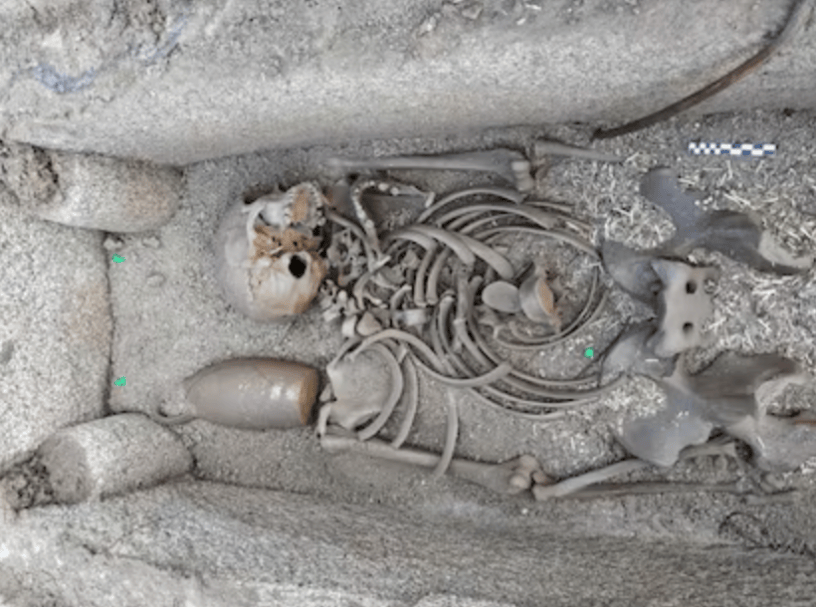
The village of El Rebollar housed a multi-ethnic community with native, Central European and African lineages.
As the academic paper reports: “Results reveal a highly diverse population mosaic: adults harbored distinct lineages, including European haplogroups H2a2 and T1a, alongside a remarkable trans-Mediterranean signal (haplogroup L3h2) linked to the Horn of Africa.”
Source: El Pais

Madrid – OCT 19, 2026 – 11:17 WEST
[ This text is an excerpt from EL PAÍS’s weekly archaeology newsletter, ‘Four Stones’. To receive the newsletter, you can sign up here .]
The study “Beyond Isolation: Mitochondrial Variability and Microregional Discontinuity at El Rebollar (Madrid, 7th Century AD),” published in the journal Genealogy, reports the findings of mitochondrial DNA testing performed on five individuals buried at the Visigothic site of El Rebollar, in El Boalo (Madrid): two adults and one adolescent (approximately 15 years old) from the 7th century AD, and two infants from the Late Middle Ages.
The results reveal a highly diverse population mosaic: the adults exhibited distinct lineages, including the European haplogroups H2a2 and T1a, along with a notable trans-Mediterranean signal in the juvenile individual (haplogroup L3h2) linked to the Horn of Africa. In contrast, both perinatal individuals (the infants) shared the indigenous Iberian haplogroup HV0, confirming the long-term demographic resilience of the local population.
In other words, archaeologists have found a surprising and diverse genetic universe in the middle of the Sierra del Guadarrama where individuals of Germanic, Ethiopian, Celtic and Iberian origin who came together 13 centuries ago.
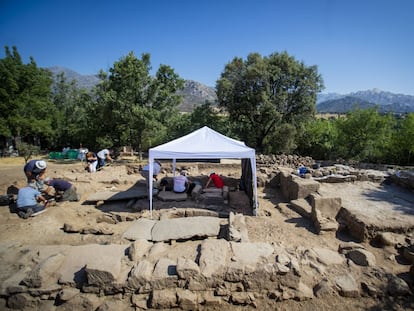
The curious thing is that this “significant genetic discontinuity on a regional scale, which isolates El Boalo from its immediate peninsular neighbors and links it with cosmopolitan sites of mixed composition (Pla de l’Horta, Girona) and with Central Europe, at the same time rules out direct flows of Gothic origin from Eastern Europe.”
The article is the result of a multidisciplinary study, funded by the General Directorate of Cultural Heritage of the Community of Madrid and the Palarq Foundation and carried out between the Autonomous and Complutense Universities of Madrid, with three fundamental pillars: the archaeological research, led by Javier Salido Domínguez (UAM), the anthropological study led by Armando González Martín (UAM) and the genetic analysis of the remains, directed by Sara Palomo Díez (UCM).
The identification of the mitochondrial haplogroup L3h2, prevalent in the Horn of Africa (present-day Ethiopia, Somalia, or Eritrea), is particularly striking, with a near-total absence in contemporary populations in Western Europe, which strongly supports a sub-Saharan African origin.
As for the newborns, they share the same maternal lineage (HV0). Since this is an indigenous lineage deeply rooted in the Iberian Peninsula since prehistoric times, the identification of the HV0 haplogroup in these newborns confirms long-term maternal biological continuity at the site, demonstrating that El Rebollar functioned as a stable and demographically active settlement.
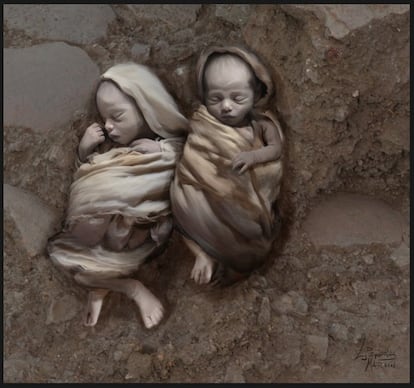
From a genetic perspective, HV0 primarily represents a deeply rooted indigenous lineage dating back to the Last Glacial Maximum (around 20,000 years ago). However, the presence of other mitochondrial haplogroups (L3H2, H2a2, and T1a) among chronologically earlier individuals is highly suggestive, as the data support the hypothesis of a dynamic, multiethnic population enclave capable of integrating individuals from diverse biogeographical origins into high-status social and funerary structures.
A comparison with the European population panorama of the same period provides extraordinary information about the demographic nature of El Boalo: while the Iberian Peninsula itself seems to be mostly isolated from its closest neighbors, in El Boalo there is less genetic distance towards Central Europe, specifically towards the Straubing site in Germany and the Hegykő site in Hungary.
This pattern is consistent with extensive paleogenomic studies conducted in post-Roman Europe, which demonstrate how long-distance mobility networks and Central European genetic contributions reshaped local communities in the High Middle Ages.
This transcontinental affinity is explained by the molecular signature of adult individuals, who share lineages such as H2a2 and, especially, T1a, a marker closely linked to the expansive demographic dynamics of Central and Northeastern Europe.
However, this pattern rules out any direct maternal link or lineage with the contingent of Gothic migrants who settled in the Balkans during the 4th century and who assimilated Sarmatian biological components or those of the steppe populations. Consequently, El Boalo’s mitochondrial connection with the rest of the continent is strictly Central-Western European in nature.
From a historical and chronological perspective, it is essential to clarify that the genetic singularity observed in El Boalo during the 7th century AD should not necessarily be interpreted as reflecting synchronous or first-generation migratory flows, given that mitochondrial DNA is transmitted unaltered from mothers to children throughout the generations.
During the 5th and 6th centuries AD, the Iberian Peninsula underwent profound demographic changes linked to the settlement of Visigoths and Suebi, as well as to the connectivity networks of the Late Antique Mediterranean. El Rebollar, situated at a strategic crossroads at the foot of the Sierra de Guadarrama, would have served as a center for the reception and integration of these migrant populations. Over generations, these non-native lineages took root locally, becoming fully integrated into the social fabric.
El Rebollar, far from being an endogamous mountain settlement, housed a multi-ethnic community in which non-local lineages —Central European (T1a), trans-Mediterranean African (L3h2) and pan-European (H2a2)— coexisted with a deep local maternal continuity, represented by the native Iberian lineage HV0 in perinatal individuals.

