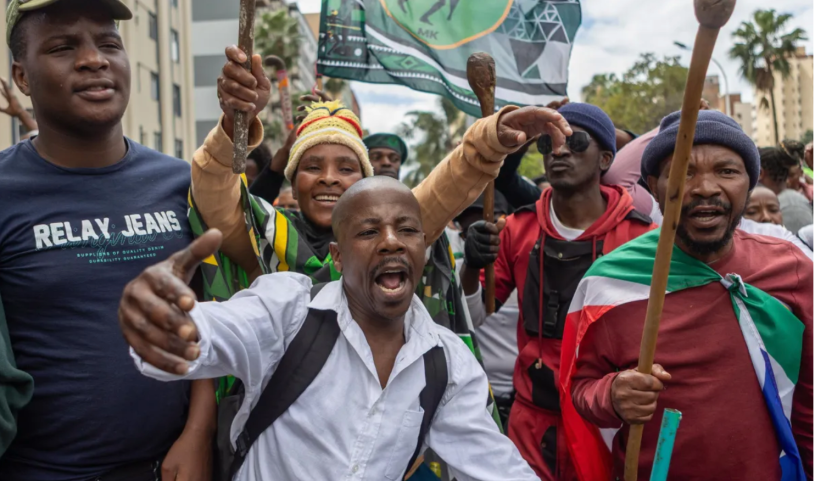
The African Commission calls on South Africa to declare the recurrent trends of violence and xenophobic rhetoric as a crisis that deserves unequivocal and multipronged action at all levels of society led by the highest levels of State authority.
Source: African Commission on Human and Peoples’ Rights
The African Commission on Human and Peoples’ Rights urges South Africa to declare the attacks on foreign nationals as a crisis following the unconscionable mob killing of a foreign national in Durban, South Africa.
The African Commission on Human and Peoples’ Rights (the African Commission), through the Chairperson of the African Commission and Chairperson of the Working Group on Death Penalty, Extra-Judicial, Summary or Arbitrary Killings and Enforced Disappearances in Africa, Honourable Commissioner Idrissa Sow, and the Country Rapporteur on Human Rights in the Republic of South Africa, Honourable Commissioner Solomon Ayele Dersso, condemns in the strongest terms the killing of a foreign national, who was beaten to death by a mob of approximately fifty (50) people in Durban, the Republic of South Africa.
Reports reaching the African Commission indicate that the foreign national was assaulted by about 50 people on 22 October 2026 in the central business district of Durban and was later pronounced dead at the scene.
The African Commission joins the South African Human Rights Commission in expressing its deep concern about this incident and in noting that the reported circumstances of the killing could constitute a crime against humanity.
The African Commission reiterates in this context the positive obligation of the Republic of South Africa to ensure the protection of all people within its territory. As stated in the General Comment No. 3 on the African Charter on Human and Peoples’ Rights on the right to life (Article 4), “The Charter imposes on States a responsibility to prevent arbitrary deprivations of life caused by its own agents, and to protect individuals and groups from such deprivations at the hands of others.”
Furthermore, the General Comment stipulates, on the Responsibility for violations by non-State actors, that “the State is responsible for killings by private individuals which are not adequately prevented, investigated or prosecuted by the authorities. These responsibilities are heightened when an observable pattern has been overlooked or ignored, such as is often the case with respect to mob-justice, gender-based violence, femicide, or harmful practices. States must take all appropriate measures effectively to respond to, prevent and eliminate such patterns or practices.”
In view of the foregoing, and the fact that such atrocious act of deprivation of life comes against the background of recurrent xenophobic narratives inciting hate and violence against foreigners, particularly those from other African States, the African Commission calls on South Africa to declare the recurrent trends of violence and xenophobic rhetoric as a crisis that deserves unequivocal and multipronged action at all levels of society led by the highest levels of State authority.
The African Commission further reminds the Government of South Africa the obligation it bears in cases of arbitrary deprivation of life particularly in the reported circumstances to conduct prompt, impartial, thorough and transparent investigation into this heinous mob killing of a fellow human being and bring perpetrators to justice.
It is the considered view of the African Commission that the speedy investigation of this tragedy and prompt revelation of the circumstances of the killing and holding accountable those responsible for this arbitrary deprivation of life will contribute to preventing further arbitrary killing by mobs and to avert the trend of vigilantism and the associated impunity from further spiralling. This intersects with the general duty, recognised in the Charter, of “all individuals to exercise their rights and freedoms with due regard to the rights of others.”
The African Commission will continue to monitor the situation closely and remains ready to engage with and support the Government of South Africa, including within the framework of the promotion mission it held, in upholding its human and peoples’ rights obligations and ensuring justice, accountability, and the protection of human and peoples’ rights in South Africa.
Banjul, 23 October 2026

