The case for compensating Africa for slavery rests on bad history, questionable morality, and false promises
by Ebenezer Obadare Commentary September 2026
From 1987 to 1990, an African millionaire set out on a personal mission advocating reparations to African countries as a form of Western atonement for the transatlantic slave trade. M.K.O. Abiola was a Nigerian businessman who traveled extensively in the United States and elsewhere to convince audiences of what he saw as a moral imperative to compensate Africa and its vast diaspora for the evils committed against them. His effort foundered, but it did serve as a valuable test run for the African reparations initiative that is now underway.
Abiola’s spirited transnational campaign culminated in two major high-level and widely publicized conferences on reparations, the first in Lagos (1990) and the second, billed as the “First Pan-African Conference on Reparations,” in Nigeria’s capital, Abuja (1993). These successes—along with Abiola’s relentlessness—caught the attention of the Organization of African Unity (OAU), an intergovernmental organization made up of 52 countries. The OAU went ahead and installed him as the chairman of a 12-member Group of Eminent Persons to “pursue reparations for slavery and (perhaps) other wrongs perpetrated on Africa.” This was the high-water mark of Abiola’s work. He died mysteriously in government custody in July 1998 after leading a campaign to reverse the military’s annulment of his legitimate election to the Nigerian presidency in 1993. Lacking Abiola’s intensity and financial backing, the reparations campaign petered out.
Today, an elite group from Ghana has decided to pick up where the Nigerian philanthropist left off. Addressing the 78th session of the United Nations General Assembly in New York in September 2023, then–Ghanaian President John Akufo-Addo agonized about what he called “the historical injustices that have fashioned the structures of the world,” including that “much of Europe and the United States” was built using “the vast wealth harvested from the sweat, tears, blood, and horrors” accruing from the transatlantic slave trade and colonization. Akufo-Addo used this observation to make a case for “bring[ing] the subject of reparations firmly to the fore,” even though he acknowledged that “no amount of money will ever make up for the horrors.”
Akufo-Addo’s successor, John Dramani Mahama (this is his second presidency; he previously served from 2012 to 2017), has shown similar gusto in his pursuit of reparations for Africa and its diaspora. With support from the African Union (the successor organization to the OAU) and some Caribbean nations, Mahama spearheaded a March 2026 United Nations General Assembly resolution “dedicated exclusively to slavery and the transatlantic slave trade.” Citing “the trafficking of enslaved Africans and racialized chattel enslavement of Africans as the gravest crime against humanity,” the resolution noted that “in various historical contexts, reparations and other forms of redress have been provided in respect of other grave crimes committed against particular groups, reflecting the principle under international law that international wrongful acts entail a duty of reparation.” The resolution called on member states to “engage in inclusive, good-faith dialogue on reparatory justice, including a full and formal apology, measures of restitution, compensation, rehabilitation, satisfaction, guarantees of non-repetition and changes to laws, programs and services to address racism and systemic discrimination.” It passed with 123 votes in favor, although the United States, Israel, and 52 other countries—including European Union members and Britain—either opposed or abstained.
Britain’s abstention is interesting when you consider that, back in 1993, 63 members of the UK Parliament had supported a motion that “welcomed” the Abuja Proclamation issued that year. Along with others, Britain had also called on “the international community to recognize that the unprecedented moral debt owed to African people has yet to be paid” and pledged support to the OAU “as it intensifies its efforts to pursue the cause of reparations.”
In any case, President Mahama followed up the March resolution with a high-level consultative conference on “the next steps.” Held in Accra in June, the event was attended by heads of state from Namibia, Liberia, Senegal, Barbados, and São Tomé and Príncipe. It ended with “a 19-point global framework” that demands “full, formal and unconditional apologies” from “states and non-state institutions” that played a “role in the trafficking of enslaved Africans and African Descendants and the racialized chattel enslavement of Africans.” Attendees also “resolved to ensure fair and adequate compensation for the people of Africa and People of African Descent, including those affected by the legacies of enslavement, colonialism genocide [sic] and apartheid.”
Before we consider the merits of the case for “reparatory justice,” it is important to understand why Ghana is leading the contemporary campaign. In 1957, Ghana became the first sub-Saharan African nation to gain formal independence, and it has always seen itself as a “beacon” for the complete liberation and unification of Africa. Its first president, Kwame Nkrumah, set this conviction in stone with his statement that Ghana’s independence “is meaningless unless it is linked up with the total liberation of Africa.” If, for Nkrumah, Ghana’s independence meant nothing without freedom for all of Africa, similarly, African independence meant little unless understood as an aspect of liberation for black people everywhere, especially in the United States. That’s where Nkrumah, who had attended the University of Pennsylvania in the early 1940s, had gotten a taste of what life was like for the average Negro of that era.
There was an ideological affinity between Nkrumah and major African-American civil rights figures of his time. This is evidenced by the fact that Ghana’s historic independence celebration in 1957 was attended by Martin Luther King Jr. This came after Louis Armstrong had visited the soon-to-be-free country and met with Nkrumah in May 1956. W.E.B. Du Bois first visited in 1960 before relocating there permanently the following year at the age of 93. Malcolm X visited in 1964, where he encountered another relocated American, Maya Angelou, and spoke to the Ghanaian Parliament. Subsequently, generations of civil rights activists and political malcontents of various stripes have embraced the country as a kind of political home-cum–spiritual retreat.
Because there is arguably nothing dearer to a Ghanaian leader’s heart than being viewed as extending the legacy of Nkrumah, successive Ghanaian leaders have continued to toe the line, touting the country as the birthplace of Africans in the diaspora. There was President John Kufuor’s 2001 “right of abode” law allowing Africans in the diaspora to settle in Ghana; the Joseph Project, launched on the occasion of the country’s 50th anniversary, in 2007; and the declaration of 2019 as the “Year of Return” to mark “400 years of the arrival of the first enslaved Africans in Jamestown, Virginia.” All of these were intended to advance the idea of Ghana as the spiritual motherland of a putative “Global African Family.”
One indication of the success of this outreach is that, since 2014, more than 1,000 Americans and Afro-Caribbeans have obtained Ghanaian citizenship—Stevie Wonder became a Ghanaian citizen on his 74th birthday, in 2024—joining an estimated 5,000 African Americans who currently call the country home. Ghana has also opened its doors to third-country deportees from the United States on condition that they are citizens of other West African countries.
All things considered, Ghana’s leadership of the reparations campaign is an extension of its heritage diplomacy.
_____________
Nonetheless, neither the goodness of its advocates’ intentions and their seemingly illustrious pedigree, nor the favorability of the international political environment suffices to alter the basic fact that the demand for “reparatory justice” is both intellectually implausible and morally dubious. The Accra “global framework for reparatory justice” portrays “the trafficking of enslaved Africans and the racialized chattel enslavement of Africans as the gravest crime against humanity” in “its unparalleled scale, duration, systemic brutality, and enduring consequences that continue to structure the lives of all people through racialized regimes of labour, property, and capital.”
The kernel of this claim is that Africa deserves reparations because of (a) the unprecedented nature of the transatlantic slave trade, and (b) the fact that, even today, its consequences continue to reverberate, mainly through the operations of capital, which is what the reference to “racialized regimes of labour, property, and capital” is meant to capture. From this perspective, not only is capitalism the contemporary version of “chattel enslavement,” hence continuous with it morally and materially, but “reparatory justice” for Africans is impossible unless capital, “racialized” or not, is totally abolished.
While the elemental inhumanity of the transatlantic slave trade goes without saying, and while the Accra document is right to underscore it, the point remains that the framework gets nearly every other thing about it—especially its fundamental character—wrong. Take the charge of the trafficking and enslavement of Africans being “the gravest crime against humanity.” History being “little more than the register of the crimes, follies, and misfortunes of mankind,” as Gibbon puts it, it is necessarily replete with victims and perpetrators. Accordingly, every victimized group in a specific historic context could reasonably conceive of itself as being on the receiving end of “the gravest crime against humanity.” My point is not to deny that enslavement was hideous; rather, I am arguing that a crime (against Africans or any group of people for that matter) need not be “the gravest” before it arouses our moral revulsion. If everything hinges on a particular crime being “the gravest,” and given that there is no objective criterion to measure such, the argument is lost and the moral high ground surrendered the moment some other victim of a historical injustice comes forward to advance a similar plea.
While it is not a straightforward matter whether the transatlantic slave trade was “the gravest crime against humanity,” surely it was a crime. It was a crime and a monumental tragedy from the perspective of tens of millions of black human lives that were sacrificed on the twin altars of greed and human stupidity. That said—and this is a crucial point—there is scant historical support for the tacit assumption that it was an organized and systematic assault against hapless Africans who, but for lack of military wherewithal, would have risen up against and repelled their enslavers. The historical evidence is more sobering. As John Thornton wrote in Africa and Africans in the Making of the Atlantic World, 1400–1800 (1998): “African participation in the slave trade was voluntary and under the control of African decision makers. This was not just at the surface level of daily exchange but even at deeper levels. Europeans possessed no means, either economic or military, to compel African leaders to sell slaves.” This conclusion is not controversial among serious historians of the transatlantic slave trade. It also helps explain the historical absurdity of those newfangled European abolitionists who, as it were, had suddenly started seeing the trade through a different moral lens and began struggling to convince African traffickers, until a minute ago their trading partners, of the wrongfulness of the enterprise.
If European abolitionists did not become saints overnight, African chiefs who insisted on business as usual were hardly Satanic. They were instead agents following a brutal social logic: So integral was enslavement to the internal workings and moral order of most African communities in that period that it is difficult to conceive of their functioning without it. Historically, a pre-colonial African kingdom that did not extract slaves from a vanquished vassal was as rare as one that did not regularly engage in slave raids. In the 1840s, Gezo, king of the West African state of Dahomey, told the importuning British, “The slave trade is the ruling principle of my people. It is the source and the glory of their wealth.… The mother lulls the child to sleep with notes of triumph over an enemy reduced to slavery.” In this, he echoed a sentiment that was not uncommon for the time.
Indeed, not only was trade in human beings par for the course, many believed that it was God’s will. After Britain declared all slave trading illegal in 1807, the King of Bonny (now part of Nigeria) doubled down in a tone not all that different from that of King Gezo: “We think this trade must go on. That is the verdict of our oracle and the priests. They say that your country, however great, can never stop a trade ordained by God himself.” Nigerian historian P.A. Igbafe observed about the pre-colonial Benin Kingdom that the institution of slavery was “one of its main props.” This could well have been said about every single pre-colonial African kingdom. The Asante Empire, with its capital in Kumasi—located in present-day Ghana—was a slave-owning one.
Rather than a “definitive break in world history,” therefore, the transatlantic slave trade was coextensive with it. That it was egregious in its brutality is without question, but it was a trade involving two sides and, crucially, seems to have unfolded within a moral and social calculus in which you were either traded or trader. It is one thing to recognize its sheer ugliness and another thing entirely to misrepresent it, which the campaigners for reparatory justice flagrantly do.
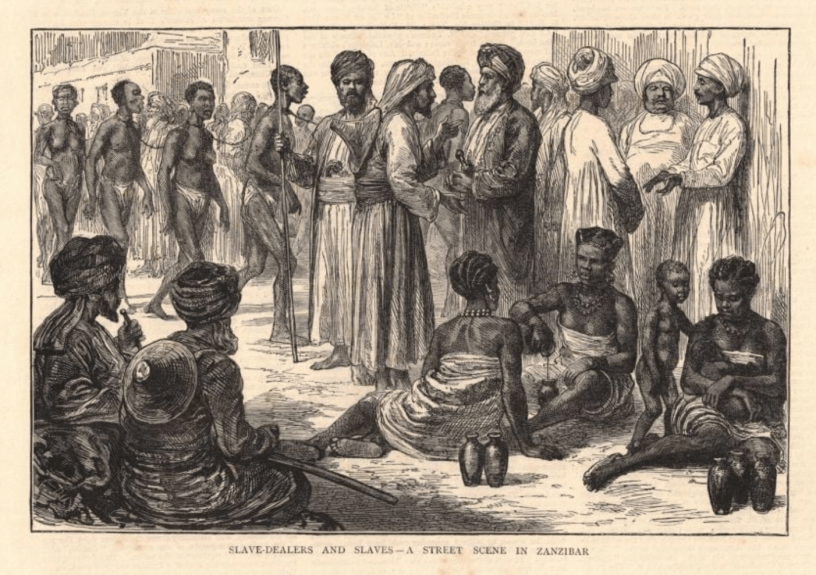
The transatlantic slave trade, moreover, is just one of three momentous episodes of human trafficking in African history, the other two being the trans-Saharan and Indian Ocean slave trades. Consider this: The transatlantic slave trade lasted roughly 400 years. The trans-Saharan lasted for 1,300 years, and it preceded, overlapped with, and continued long after the transatlantic slave trade had ceased. Focusing solely on the transatlantic trade leads one to think that those behind the ongoing campaign are less interested in historical accuracy and more interested in exploiting the supposed “lingering trauma” of the transatlantic slave trade for purposes of political flagellation.
_____________
Following the March UN General Assembly resolution, analysts were quick to point out that, although the resolution was adopted by a majority, the United States, Israel, and 52 other countries either opposed or abstained. But the stance of these dissenting countries is less significant than the fact that Arab countries overwhelmingly endorsed the resolution. Several, including Qatar, were among the resolution’s 58 co-sponsors.
The naked hypocrisy of Arab countries passing judgment on a matter on which they should be standing trial is duly noted, but it raises another matter: Why did the countries that voted in support of the resolution do so? My intuition is that many simply wanted to avoid unnecessary controversy. After all, why vote no when you can blend with the furniture by voting yes? If I am correct, it means that the broad support that the reparatory-justice campaign takes for granted may not be there. Perhaps the large number of those who are apparently on board with the resolution understand, deep down, that the campaign is heading nowhere. They therefore have nothing to lose and everything to gain from identifying with a cause that has the added advantage of being regarded as just.
Beyond questions of historical accuracy, the campaign betrays a staggering lack of imagination on the part of its proponents. While in recent decades conversations about Africa have been dominated by a need to take African agency more seriously, the advocacy for reparatory justice reveals a nagging moral extraversion whereby many African leaders continue to obsess about the role of the outside world in their affairs. Wittingly or not, the campaigners are sending a misleading signal that Africa cannot develop until it is reimbursed for an injury that Europeans once ganged up to inflict on it. This is the flip side of the abject idea that other regions of the world, Europe and North America especially, have succeeded at the expense of Africa and Africans. To say that this is the last attitude Africa needs is an understatement. The campaign is an exercise in futility that can only divert from the region’s real problems. In the meantime, it is allowing corrupt and ineffective leaders to disguise their incompetence behind the facade of “historical reckoning.”
Photo: Ernest Ankomah/Getty Images

