After four years of fragile peace, fighting between Tigrayan People’s Liberation Front (TPLF) and government forces threatens to restart brutal conflict.
Authors
Jalale Getachew Birru
Regional Expert, East Africa
Clionadh Raleigh
CEO
✓ ACLED is the world’s most trusted source of conflict information >
Track the latest developments: ACLED ALERTS: Ethiopia Conflict Live
Expert insight: 28.09
11:00 (GMT)
Dr Jalale Gettachew Birru, East Africa Senior Analyst at ACLED said:
“Ethiopia celebrated Meskel over the weekend with calls for peace and unity, but fighting continued across Amhara, Tigray, and Afar, alongside growing accusations over external support for the different sides.
“For now, the federal government appears to regard the renewed fighting as a manageable challenge. Its crucial trade and supply corridor through Djibouti remains open, while government forces have regained ground in and around Sekota in Wag Hamera zone and Alamata in Southern Tigray zone.
“The TPLF’s advance in collaboration with Ugugumo into Afar could change that calculation if it threatens the Semera-Djibouti route. But disrupting the corridor would also risk antagonizing Djibouti, an important regional partner that does not have a relationship with the emerging anti-government alliance. Control of this route could give the TPLF significant leverage over the federal government by threatening Ethiopia’s main trade corridor to the port of Djibouti.”
Expert insight: 26.09
16:30 (GMT)
Dr Jalale Gettachew Birru, East Africa Senior Analyst at ACLED said:
“The picture around the newly announced Alliance for Survival is becoming clearer, and more contested. The Gumuz Peoples Democratic Movement has denied being part of the alliance, saying it currently has no armed wing. Meanwhile, the Ogaden National Liberation Front stated it was not part of the alliance, while the other wing confirmed it was a member and indicated its interest was not in restarting an armed struggle but rather in removing the current government led by Prime Minister Abiy. The Oromo Liberation Army — also known as the Oromo Liberation Front-Shane — indicated that its main interest in the alliance is to remove the government rather than to conduct a coordinated operation. Hence, only the Tigray People’s Liberation Front, the Amhara Fano National Movement, and the Afar Revolutionary Democratic Unity Front (Ugugumo) are currently fighting the security forces in the Tigray, Amhara, and Afar regions since 22 September.”
Expert insight: 25.09
14:00 (GMT)
Dr Jalale Gettachew Birru, East Africa Senior Analyst at ACLED said:
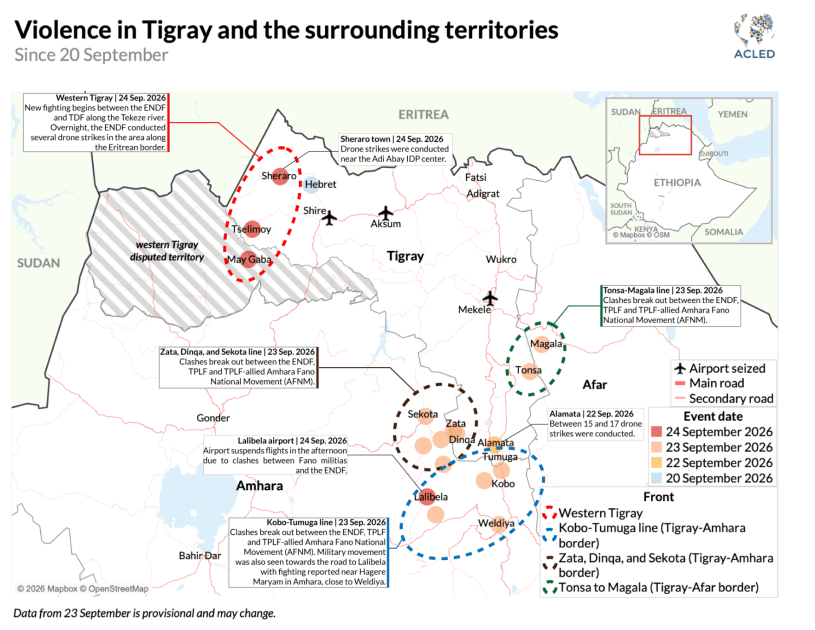
Northern Ethiopia’s war is opening on multiple fronts
“The significance is not simply that fighting has intensified. Several military fronts are now active simultaneously, civilian areas are being exposed to airstrikes, communications are being disrupted and political divisions within Tigray are becoming increasingly visible. Together, these developments make the conflict considerably more difficult to contain.
“What we are seeing over the past few days is a conflict expanding in several directions at once. Fighting is no longer concentrated along one front. Clashes have spread across the Tigray-Amhara border, into Afar and towards western Tigray, while repeated drone strikes have been reported across Tigray and north Amhara.
“On 22 September alone, ACLED sources reported between 15 and 17 drone strikes in Alamata in Southern Tigray zone, with schools, a hospital and other locations among the reported targets. Further drone strikes were reported in Northwestern Tigray zone on 23 and 24 September. The number of casualties remains unclear, but civilians and combatants have reportedly been killed.
“At the same time, fighting involving federal forces, the Amhara Fano National Movement, and Tigraya Defense Forces (TDF) has spread across multiple locations in North Wello and Wag Hamera zones in Amhara, resulting in the suspension of flights at Lalibela airport on 24 September afternoon. A further front has opened around the Tekeze River in Tslimoy and May Gaba in the disputed western Tigray area, showing just how quickly the geography of this conflict is expanding.
“There are also signs of growing pressure inside Tigray itself. Telecommunication services operated by Etio-Telecom have been disrupted across Tigray, except western Tigray, making information increasingly difficult to verify, while senior Tigrayan military figures and members of the Tigray People’s Liberation Front, including former interim regional president Tadesse Werede and head of intelligence for TDF, have reportedly been detained after being accused of sharing information with the federal government.”

