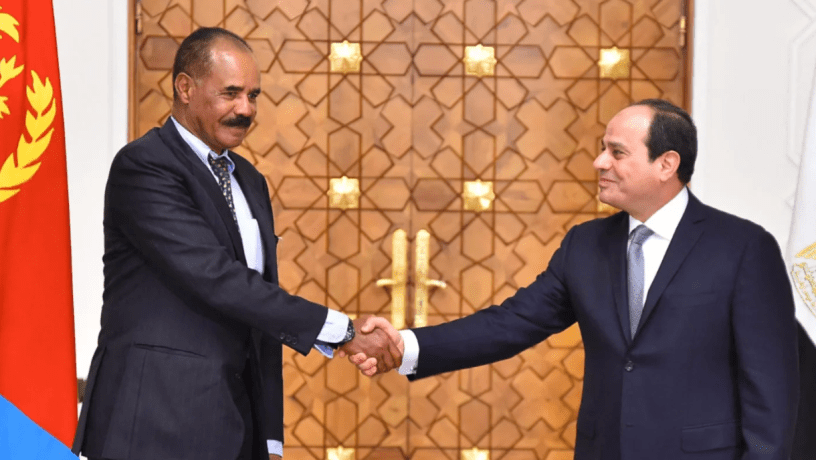
Ethiopia faces another unintended consequence of its regional strategy. Its pursuit of sea access—whether through agreements with Somalia or historical claims related to the Red Sea—has encouraged neighboring states to deepen their security cooperation…Egypt saw an opportunity to increase pressure on Ethiopia over the GERD. As a result, the interests of Egypt, Eritrea, and Somalia converged, producing an emerging strategic alignment against Ethiopia.
By Ephrem B Hidug
By focusing primarily on the Grand Ethiopian Renaissance Dam (GERD), recent commentary on the visit of a senior U.S. official to Cairo risks missing the larger strategic picture. Hermela Kidane, writing for The Horn Review, argues that the recent diplomatic tour of Massad Boulos, Senior Advisor for Arab and African Affairs in the U.S. administration was fundamentally about GERD and urges the Ethiopian government to pursue wiser diplomacy. She may well have evidence unavailable to the public, and her call for more effective diplomacy is timely. But Ethiopia’s diplomatic challenges cannot be understood through the lens of GERD alone.
Ethiopia’s Foreign Policy Challenge
The country’s greatest foreign policy vulnerability today is not the dam itself. It is the combination of domestic political instability and an inconsistent foreign policy that has failed to capitalize on Ethiopia’s considerable strengths.
Every state pursues its national interests. Successful foreign policy begins with a clear understanding of those interests, an honest assessment of national strengths and weaknesses, and careful consideration of how other states perceive and respond to one’s actions. Ethiopia is no exception.
Unfortunately, interviews by Prime Minister Abiy Ahmed suggest that Ethiopian leadership has too often used public statements as instruments of domestic politics rather than as tools of strategic diplomacy. Every public declaration is carefully analyzed by foreign governments seeking to understand Ethiopia’s intentions. If states invest enormous resources in gathering intelligence on one another, they certainly pay close attention to official speeches and policy statements. Leaders’ public statements, media messaging, and strategic narratives. Therefore governments must craft their strategies and actions with utmost care. Strategic communication is not merely political rhetoric; it is an important element of national security.
In contrast, Egypt has demonstrated strategic consistency on the Nile issue. For decades, it has treated the Nile as a core national security interest, embedding water security within its constitutional and strategic frameworks [see Constitution of the Arab Republic of Egypt Art44]. Cairo has strengthened its position through bilateral cooperation with Sudan and Somalia, engagement with the Arab League, active diplomacy in international forums, and by leveraging its geopolitical importance in the Red Sea and the Middle East.
Ethiopia’s GERD Diplomacy: Regional Realities and Strategic Lessons
Ethiopia needs to understand why Egypt has been able to mobilize international support on the Nile issue. Its strategic location, its role in the Red Sea, and its importance in Middle Eastern politics have significantly enhanced its diplomatic influence. There is nothing unusual about Ethiopia aspiring to regain sea access or to increase its geopolitical importance. But such ambitions require careful long-term planning, consistent diplomacy, and realistic assessments of regional reactions. This cannot be pursued through rhetoric alone or treated as short-term political projects.
However, it required understanding of Egypt’s position and examining the broader regional context, including the Palestinian issue, the Israel-Hamas conflict, and the strategic calculations of major powers operating in the Middle East and the Horn of Africa.
It should be observed that Egypt’s importance increased further after the Hamas-Israel war, during which Cairo played a central mediation role. Its expanding strategic partnerships with both Europe Union and the United States have inevitably strengthened its diplomatic position on regional issues, including GERD.
This broader context also helps explain the consistency of Washington’s position. During his first administration, President Donald Trump publicly insisted that Ethiopia should negotiate over GERD and made controversial remarks suggesting that Egypt might eventually resort to military action against the dam. Since returning to office, he has again emphasized his close relationship with Egypt’s leadership and reiterated concerns about Nile water issues. Whether one agrees with these positions or not, they demonstrate that American policy on GERD is rooted in broader strategic interests rather than any single diplomatic visit.
If Ethiopia wishes to strengthen its international position, it must first strengthen itself. No foreign policy can compensate for domestic instability. Internal conflict, economic uncertainty, and political fragmentation inevitably weaken the country’s negotiating position, regardless of how skillfully its diplomats perform abroad.
Equally concerning has been the absence of a coherent regional strategy.
The Cost of Strategic Miscalculation
The government’s pursuit of sea access illustrates this challenge. While the issue may have served domestic political purposes by shifting attention away from internal crises and rallying nationalist sentiment, it also altered regional security calculations. Ethiopia’s increasingly assertive rhetoric regarding access to the Red Sea alarmed neighboring states and encouraged closer coordination among them.
Foreign policy should anticipate such reactions rather than provoke them.
The government’s approach to Eritrea reflects similar strategic shortcomings. Despite decades of research documenting Eritrea’s political system and regional behavior, Ethiopian policymakers underestimated the long-term implications of their partnership with President Isaias Afwerki. The reconciliation between Prime Minister Abiy Ahmed and the Eritrean leadership was celebrated internationally, culminating in the Nobel Peace Prize. Yet the relationship soon evolved into a military alliance during the Tigray war, drawing Eritrean forces into the conflict and leaving lasting damage to Ethiopia’s internal cohesion and international reputation.
That partnership ultimately proved unsustainable because it rested not on enduring shared interests but on a temporary convergence against the TPLF. Once those interests diverged, so did the alliance.
How Ethiopia United Its Rivals
Today, Ethiopia faces another unintended consequence of its regional strategy. Its pursuit of sea access—whether through agreements with Somalia or historical claims related to the Red Sea—has encouraged neighboring states to deepen their security cooperation.
Eritrea and Somalia are individually much weaker than Ethiopia in terms of military capability, economic strength, and population [see global firepower]. However, Ethiopia’s pursuit of port access and rhetoric perceived as threatening created domestic political pressure in both countries. Their governments responded by portraying Ethiopia as a threat to their sovereignty and territorial integrity, strengthening domestic support for closer security cooperation. At the same time, Egypt saw an opportunity to increase pressure on Ethiopia over the GERD. As a result, the interests of Egypt, Eritrea, and Somalia converged, producing an emerging strategic alignment against Ethiopia.
Sudan Conflict and Ethiopia’s Strategic Shift
Sudan is immersed in an internal conflict with the RSF (Rapid Support Forces). The conflict has intensified and reached its most severe stage. Ethiopia has been accused of supporting the RSF and allegedly providing a training hub within its territory. Ethiopia’s calculation, according to some analysts, was that Sudan’s government under General Abdel Fattah al-Burhan has close relations with Egypt, and therefore Ethiopia needed to find a counterforce within Sudan.
Many argue that Ethiopia’s involvement was influenced by pressure from the UAE to become engaged in Sudan’s internal conflict. Meanwhile, Sudan, which was previously considered a supporter of Ethiopia’s GERD, has shifted its position and strengthened its alliance with Egypt, criticizing Ethiopia’s dam policies and pledging support for Egypt’s position.
Why did this shift happen? For Ethiopia, the success of the RSF could have created an influential partner in the Horn of Africa. However, this assumption was based on a fragile political calculation because alliances and power dynamics in the region are constantly changing. Ethiopia’s engagement in Sudan may ultimately prove to be a strategic miscalculation, as it has contributed to surrounding Ethiopia with states and actors seeking to counterbalance its regional influence and protect their own interests.
Beyond the GERD: A Strategic Reflection
Domestically, the Ethiopian government also raised public expectations by making sea access a national priority. This has left it politically constrained: failing to deliver risks damaging its credibility, while pursuing the objective more aggressively could further isolate Ethiopia. Rather than strengthening Ethiopia’s regional position, this strategy has encouraged its neighbors to coordinate against it—an outcome that could have been anticipated and avoided.
The broader lesson is clear. Ethiopia’s diplomatic challenges stem less from foreign conspiracies than from strategic miscalculations at home. Effective diplomacy requires internal stability, disciplined strategic communication, realistic assessments of regional power dynamics, and policies guided by long-term national interests rather than short-term political gains.
Protecting the GERD requires more than technical negotiations or diplomatic lobbying. It depends on rebuilding Ethiopia’s broader strategic position. A country divided internally and uncertain about its regional strategy cannot maximize its influence abroad. Ethiopia’s greatest diplomatic asset has never been the dam alone—it has always been the strength, stability, and credibility of the Ethiopian state.

